Wild begonia in Mayan rain forest is an edible plant?
Posted February 25, 2019
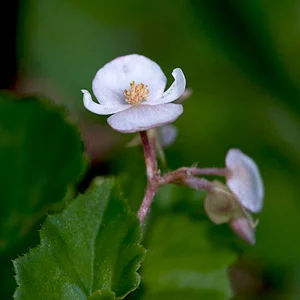
Photograph by Dr Nicholas Hellmuth, with a Nikon D810, Nikon AF-Micro-NIKKOR 200mm f/4D IF-ED Macro lens, f/13, ISO 1,250
There are thousands of wild begonia plants flowering on both sides of the rural road from Cahabon to Senahu, Alta Verapaz. If you travel other remote trails you will see other colors of begonia in open sunny areas. And wild begonia plants often grow on Mayan pyramids in Peten area and elsewhere. So begonias are a common wild plant in many different parts of Guatemala (and Mexico, etc.)
Last week we were surprised to find white-flowered wild begonia plants in a bog-like wet area filled with tree-sized Acrostichum danaeifolium ferns. This wet muddy area was constructed by the Classic Maya less than a kilometer from Poza Maya, a satellite site of Yaxha (Peten, Guatemala). You can see this Mayan-enhanced rectangular “aguadas” area north of Yaxha on Google maps (satellite view).
All the park rangers told me that their parents and grandparents ate the fresh stems of this begonia. But so far I have not (yet) found begonias in lists of edible foods: begonia is missing from my Mayan food plants list and missing from that of Lundell (1938). I bet begonias are missing from 80% of lists of edible foods for the Mayan people, including in helpful botanical monographs on plants of the Mayan areas.
But if you spend an hour searching, you gradually learn that many species of begonia are indeed eaten in parts of Mesoamerica. Our inspiration at FLAAR (USA) and FLAAR Mesoamerica (Guatemala) are to bring back the healthy edible plants which are native to the diverse ecosystems of Guatemala, Belize, Mexico, Honduras, and El Salvador. So today we resurrect the begonia. We will identify the species from Parque Nacional Yaxha Nakum Naranjo as soon as possible. We thank the park ranger Teco (Moises Daniel Perez Diaz) for telling us about the edibility of this plant.