
 |
 |
 |
 |
 |
 |
 |
 |
 |
 |
 |
 |
 |
 |
 |
Reports by FLAAR Mesoamerica
on Flora & Fauna of Parque Nacional Yaxha Nakum Naranjo
Peten, Guatemala, Central America
Full-Figure Personified Maya Hieroglyphs now available in a Thousand-Page MA thesis
Posted July 1, 2025
by Nicholas Hellmuth
Since I have been studying full-figure Maya hieroglyphs for several years, I was pleasantly surprised to find a 1,064 page opus that is the most comprehensive list (inventory, catalog) of full-figure Maya hieroglyphs ever published.
He shows more full-figure Maya hieroglyphs than Morley, Thompson and all other books “Introductions to Maya Hieroglyphs” combined. I have been preparing lists of full-figure Maya glyphs since 2023 and I estimate that Mauricio Moreno Magariño has found and documented many more that I had not yet found.
If you are an epigrapher, iconographer or archaeologist this thousand-pages of hieroglyphic research is essential. It is the most comprehensive corpus of full-figure glyphs ever amassed—with the majority cited as to source (site and sculpture name), illustrator, and where published.
If you are a student or member of the interested public, and you would like to learn more about Maya hieroglyphs, full-figure glyphs are the easiest way to learn—since each glyph is literally a complete bird, complete jaguar, complete rabbit, etc. So they are not just symbols.
 |
|
With the permission of Mauricio Moreno Magariño we are posting his MA thesis on the FLAAR web site. His drawings are excellent and include the remarkable full-figure hieroglyphs of Yaxchilan Throne 2, one of the most amazing full-figure text other than the many at Copan, Quirigua, Yaxchilan, Palenque and elsewhere.
|
Full-Figure Hieroglyphs in three Maya Codices Codex Dresden, Codex Madrid and Codex Paris
Posted July 1, 2025
by Nicholas Hellmuth
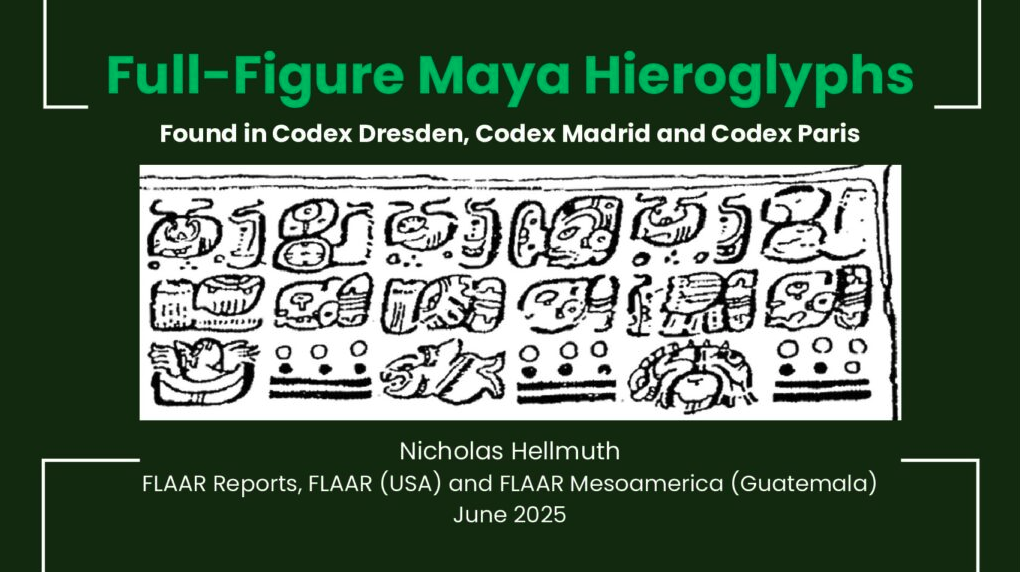
80% of helpful studies of full-figure Maya hieroglyphs have been on stone sculptures (stelae, lintels, altars, wall panels, etc.) and 20% have found and make available full-figure hieroglyphs on artifacts, especially Maya vases and bowls, found usually in burials and cached offerings. I now add to these helpful studies a comprehensive catalog (inventory, list) of 98% of all full-figure hieroglyphs in the three Maya codices. I estimate that there could be another few glyphs that I missed. Mauricio Moreno kindly sent me two images that I added. Any other examples would be welcomed.
 |
|
Full-Figure Maya Hieroglyphs Found in Codex Dresden, Codex Madrid and Codex Paris |
What the Classic Maya actually had available for Food is very different than how Classic Maya Food Sources are presented in Books, Sympsosium Presentations, and Scholarly Articles
Posted February 21, 2025
by Nicholas Hellmuth
 |
|
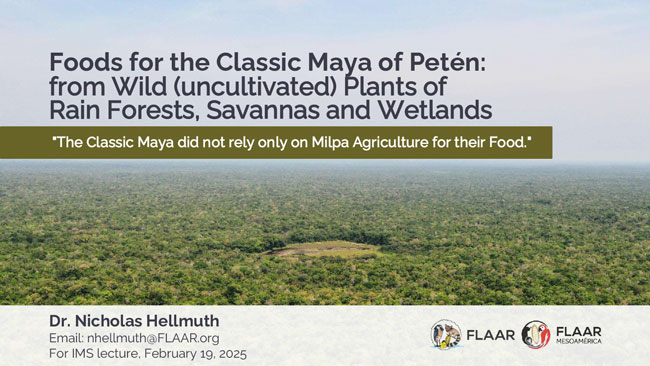
Complete two-hundred pages of photographs of flowers, fruits, leaves, of vines, trees, palms and LOTS of other wild plants native to the Peten rain forests that were available to the Clas-sic Maya for thousands of years. |
Before the lecture for IMS (Institute for Maya Studies) we showed a preview—now here are the complete 200+ pages of beautiful photos of edible wild plants of savannas of Parque Nacional Yaxha, Nakum, Naranjo and Parque Nacional Laguna del Tigre, Peten.
We show the flowers in addition to the actual plants and fruits, and show the swamps and savannas where we found all these edible wild plants during recent six years of field work in remote areas of the Reserva de la Biosfera Maya, RBM.
Palm Paradise Peten—“Islands” of Solid Palm Trees in PNYNN
Posted February 18, 2025
by Nicholas Hellmuth
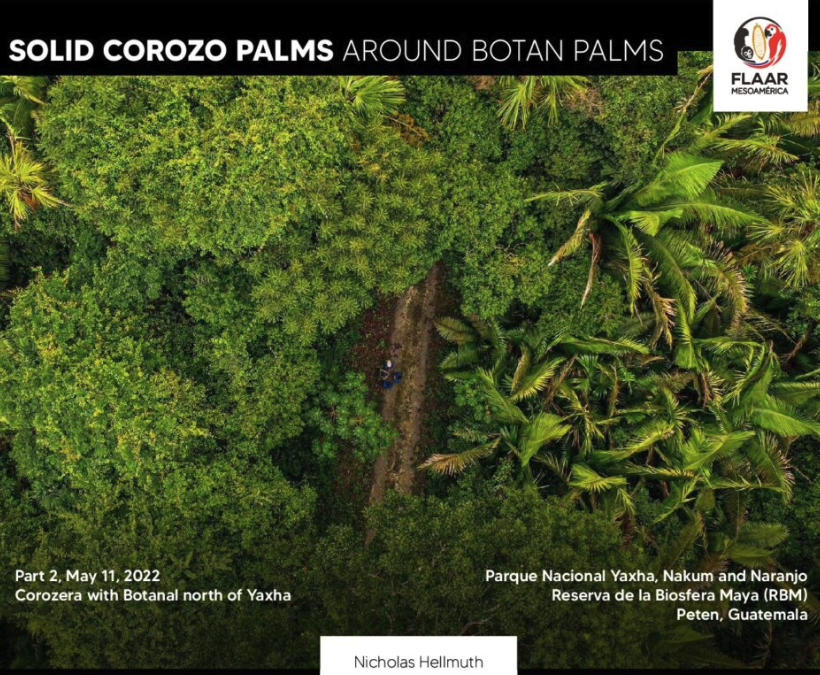
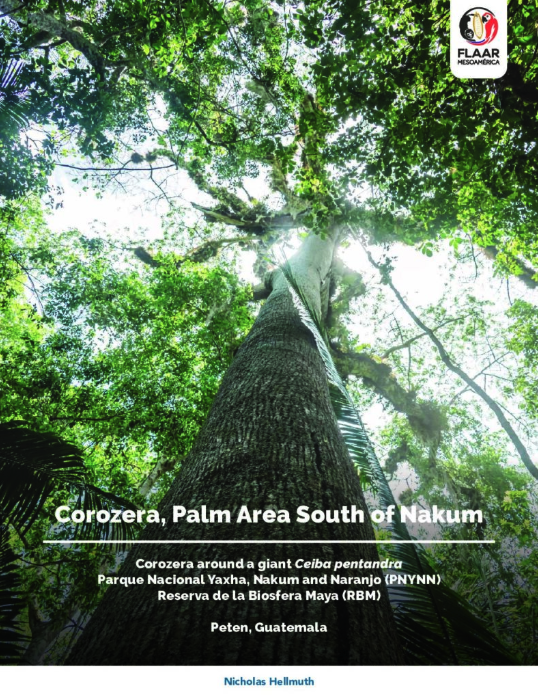
In the 1970’s, while hiking from Yaxha to improve an earlier map of Nakum, the FLAAR team experienced two incredible islands of solid corozo palms so thick with palms that it was amazing. Local people call these a corozera. They are an estimated 80% corozo palm and 10% guano/botan palm—so 90% solid palm trees as far as the eye can see. We have documented the two “palm islands” between Yaxha and Nakum (see below) and now for April 2025 will be hiking to a previously unexplored and undocumented “solid palm jungle area” to the east of the main trail (a corozera that park ranger Teco, Moises Daniel Perez Diaz, told us about recently).
We will also document an escobal/botonal “island” of escoba and botan palms west of Nakum. Then drive through Tikal National Park to reach Uaxactun to explore an amazing corozera south of Uaxactun. We will also document, photograph and map two corozeras adjacent to the Maya ruins of Naranjo-Sa’al. In future field trips, once we have suggestions by park administrators and park rangers at other parks, we wish to document more ecosystems that are solid palms (each about the size of one or two football fields). Most are surrounded by bajo vegetation but the one south of Uaxactun and one at the entrance of Naranjo-Sa’al are partially on karst limestone hills.
Palm Paradise Peten can attract eco-tourists who want to walk through a palm area that no TV documentary has ever shown. Eco-tourism helps encourage to protect fragile ecosystems and provides income for local guides and local hotels.
It would help if a kind soul or foundation could donate the funds so we can purchase a multi-spectral drone—these can map each ecosystem and show from the air the boundary of each “island of palm”. If the helpful individual or family can also donate the cost of a field trip, they can come along and experience the Palm Paradise Peten together with the team of FLAAR (USA) and FLAAR Mesoamerica (Guatemala). This project is part of the 5-year program of cooperation and coordination with CONAP (Consejo Nacional de Áreas Protegidas) and with the administrators of each national park in this Neotropical rain forest area of Guatemala.
 |
 |
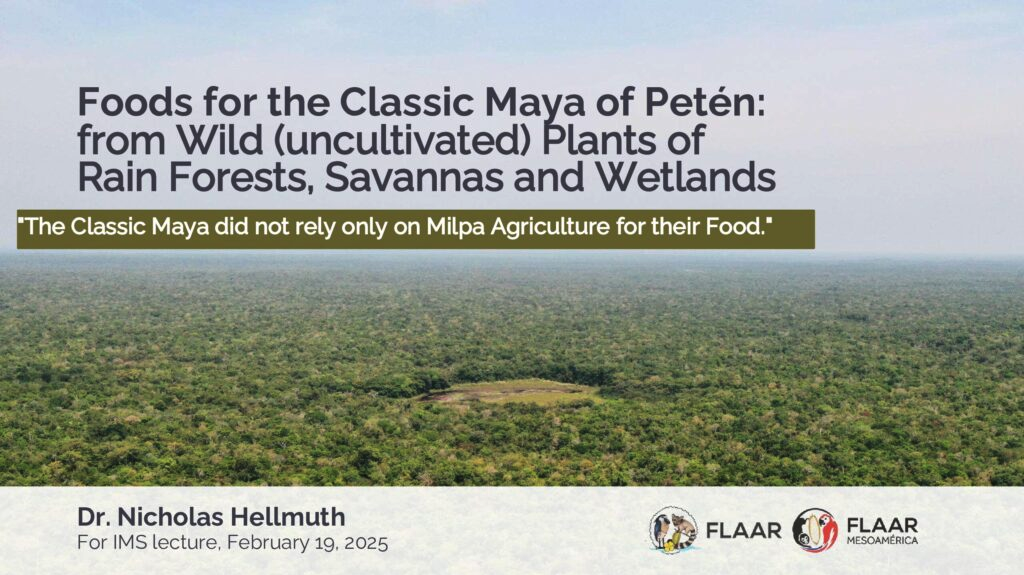
Besides Maize, Beans and Squash, what did the Classic Maya Eat? We now show you HUNDREDS of WILD edible plants that require no agriculture.
Posted February 14, 2025
by Nicholas Hellmuth
 |
|
Preview of the Feb 19th lecture as an easy download. |
There are edible flowers, edible leaves, edible roots and tubers, and obviously edible seeds, nuts and fruits—ALL from WILD tropical plants—that do not require destructive slash-and-burn milpa agriculture.
During many decades the teams of FLAAR (USA) and FLAAR Mesoamerica (Guatemala) have been accomplishing library research and field trips to learn about which WILD plants are edible. The Parque Nacional Yaxha, Nakum, Naranjo asked us to undertake field work on undocumented flora, fauna and ecosystems for a year (circa 2018). The Municipio de Livingston was so impressed with our findings in Peten that they asked us to undertake 18 months of research and field work in Izabal, so we did more than a dozen one-week field trips into remote areas of the Caribbean coast and found LOTS of edible and usable palm trees—one had the strongest fibers, so strong they would be amazing for house construction.
Then CONAP (Consejo Nacional de Áreas Protegidas) requested a project of coordination and cooperation for five years in the entire Reserva de la Biosfera Maya. We focused on PNYNN, PANAT, and PNLT. In PNYNN and PNLT we found dozens of savannas and other ecosystems not documented by earlier ecologists, geologists or botanists or archaeologists because to reach these areas is many kilometers of hiking back-and-forth (and no hotel to recuperate in—we stay in tents surrounded by the jungle).
For WEDNESDAY, February 14, at 8 PM ET we will present over 200 remarkable photographs of ecosystems, flowers, and other plants that are WILD and EDIBLE.
Access and download this active hyperlink: https://us06web.zoom.us/j/86930585524
History of the Mystery of the “Blom Plate”
Posted January 20, 2025
by Nicholas Hellmuth
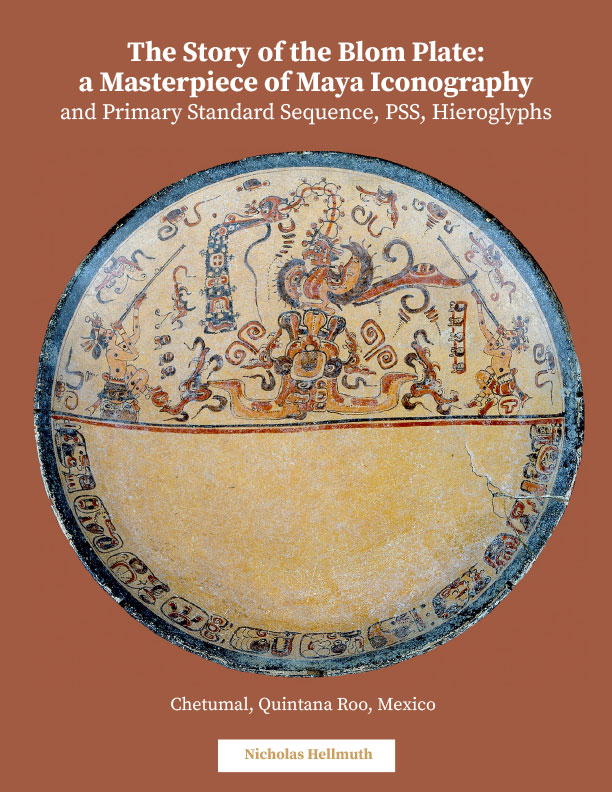
In 1950 Frans Blom published a black-and-white photo of a polychrome Maya plate that shows the Hero Twins, the Principal Bird Deity, and a well-preserved Primary Standard Sequence of hieroglyphs. For my 1980’s PhD dissertation I wanted a full color photograph and close-up photos of each part of the scene. But how do you find the plate—it was obtained by the engineer who was working on building the landing field of the Chetumal airport. The bulldozers flattened pyramids and obviously there were Maya tombs there in the 1940’s.
The FLAAR Reports on this plate details how I finally found where in Oaxaca the engineer had retired to. He kindly allowed me to photograph the plate. Since he noticed how much interest I had in studying the plate, and since he had it since at least 1949 and now in the 1980’s he himself was no longer interested in it, he asked me what he should do with the plate—but I explained that I do not collect artifacts and that since the plate was an important part of the national patrimony of Mexico, it should be available to all scholars and it should be donated to IHAH. As a result the plate is now in an IHAH museum in Mexico.
 |
|
The Story of the Blom Plate: a Masterpiece of Maya Iconography and Primary Standard Sequence, PSS, Hieroglyphs |
Early Classic Maya Cylindrical Tripods—List and Descriptions
Posted January 9, 2025
by Nicholas Hellmuth
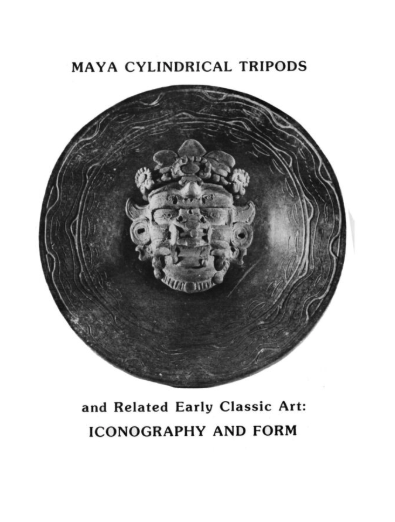
This is a comprehensive Corpus of Maya Cylindrical Tripods in Site Reports and in Museums and Private Collections Guatemala, Honduras, Mexico, USA, Canada, Europe, and Asia that were known up to 1985.
244 pages of lists and description of the iconography of Early Classic Maya cylindrical tripods known from publications and a quarter-century of photography around the world in museums and private collections by Nicholas Hellmuth. 6 photographs. This is a scan of the original published monograph to make the book available today to students and scholars as an easy download. Provides the FLAAR Photo Archive contact sheet number of the majority of the photos to assist Dumbarton Oaks, Trustees for Harvard University, to catalog the FLAAR Photo Archive that was donated there in late 2024.
 |
|
MAYA CYLINDRICAL TRIPODS, and Related Early Classic Art: ICONOGRAPHY AND FORM, in Site Reports and in Museums and Private Collections, Guatemala, Honduras, Mexico, USA, Canada, Europe, and Asia |
Holiday Greetings with 403-page Gift for you
Posted January 3, 2025
by Nicholas Hellmuth
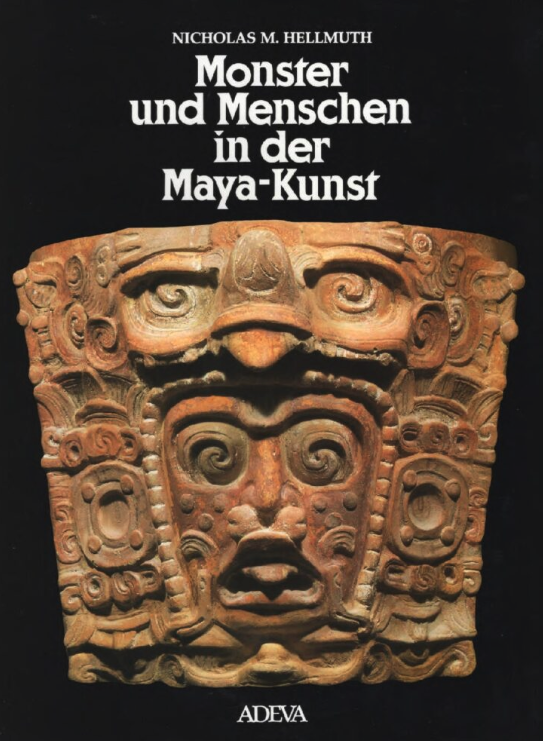
Decades of research and photography of Maya art in museums around the world resulted in a 403-page coffee-table publication of Hellmuth’s 1986 PhD dissertation. Michael Coe wrote the Foreword (in English). Book text is auf Deutsch but captions, summary, list of deities, and discussion of Maya archaeology are in English. Beautifully published by ADEVA, Graz.
727 illustrations make this book a helpful resource for iconographers, epigraphers, and archaeologists. These illustrations also assist students for their term papers, theses, and PhD dissertation. Any illustration can be used by students and scholars simply by citing the book, publisher, author, illustrator, and figure number--in other words, we waive the copyright for the FLAAR illustrations—the goal of research and publications should be non-profit and to assist the academic community.
 |
|
Monster und Menschen in der Maya-Kunst, 727 drawings and photos in book of 403 pages. 109 MB file size so the drawings can be enlarged to help your research in iconography or epigraphy. |
This book on iconography and cosmology introduces the Surface of the Underwaterworld of Maya mythology. Also features God GI cache vessels (front cover and lots more inside). Has chapter on the Jaguar God of the Underworld (JGU). Introduces the Lily Pad Headdress Monster, the Shell Wing Dragon, and the Tubular Headdress Monster. Documents that the Principal Bird Deity is a Snake Hawk. Lots of illustrations of God N.
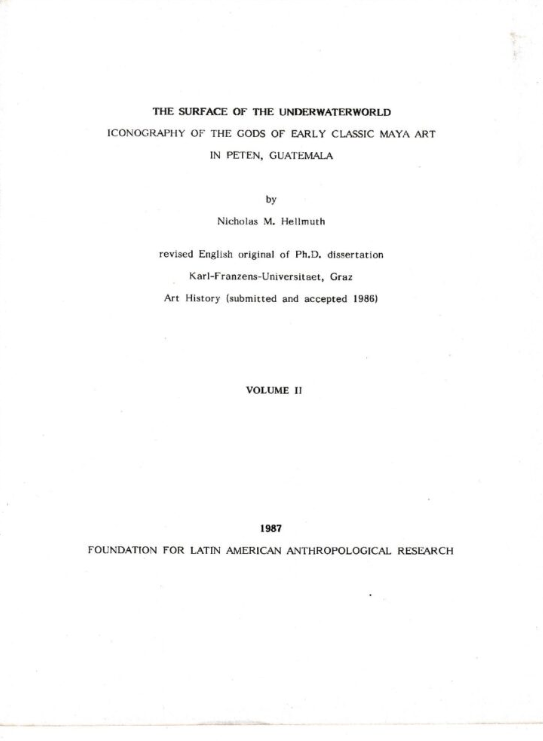
Two more holiday gifts are the two volume English edition in 1987 of Hellmuth’s 1986 PhD dissertation at Karl-Franzens Universitaet, Graz, Austria. While living in Graz for many years, I appreciate the hospitality of Hasso Hohmann and Annegrette Vogrin for living space and library and photo archive space in their home. We appreciate the sharing of information with Karl-Herbert Mayer.
 |
 |
|
Surface of the Underwaterworld, 1987 publication of English edition of Hellmuth’s PhD dissertation, Vol. I, text, 306 pages. |
Surface of the Underwaterworld, 1987 PhD, Vol. II, illustrations, 255 pages. 159 MB file size so that the line drawings are at a digital resolution to help you see details. |
The purpose of posting these books is to make the illustrations available to students and scholars so they can advance Maya cosmology, iconographic, epigraphic, and archaeological discussions since today as we enter 2025 a lot more documentation is available to allow advances over what was known in the 1980’s.
Merry Christmas 2024 and Happy New Year 2025
Posted December 24, 2024
by Nicholas Hellmuth
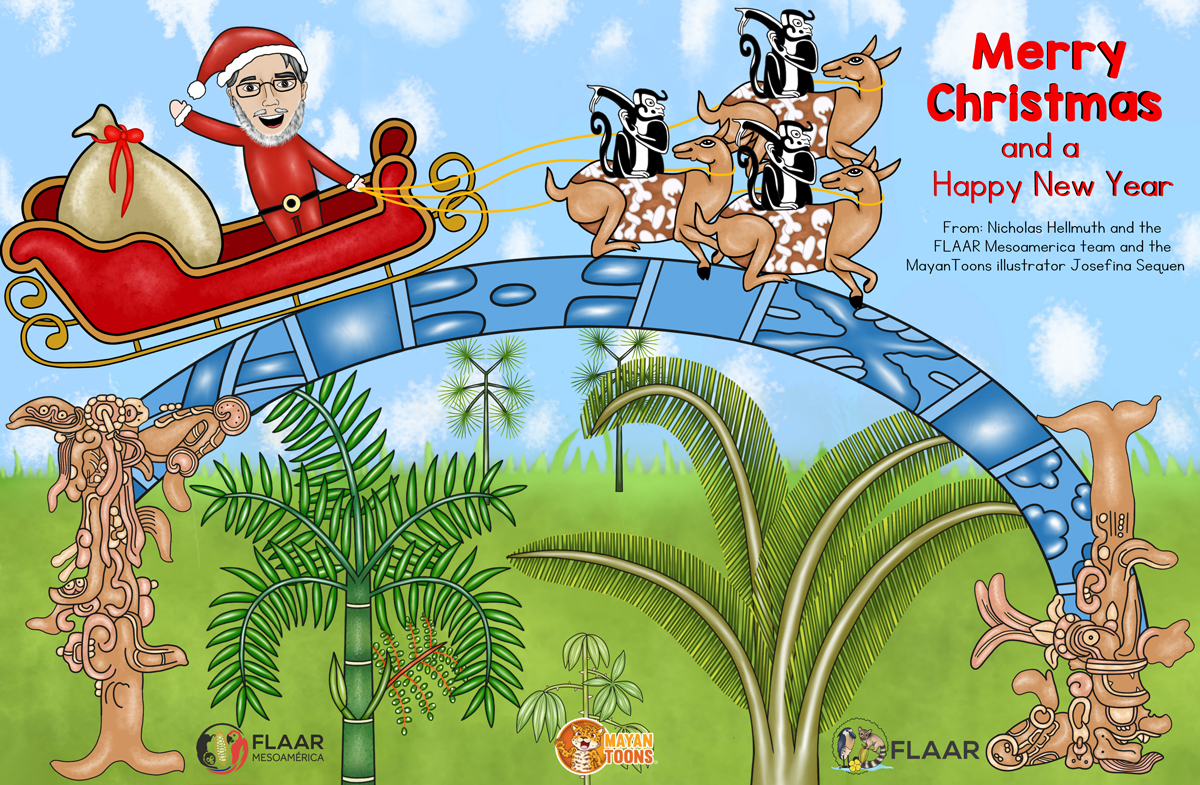 |
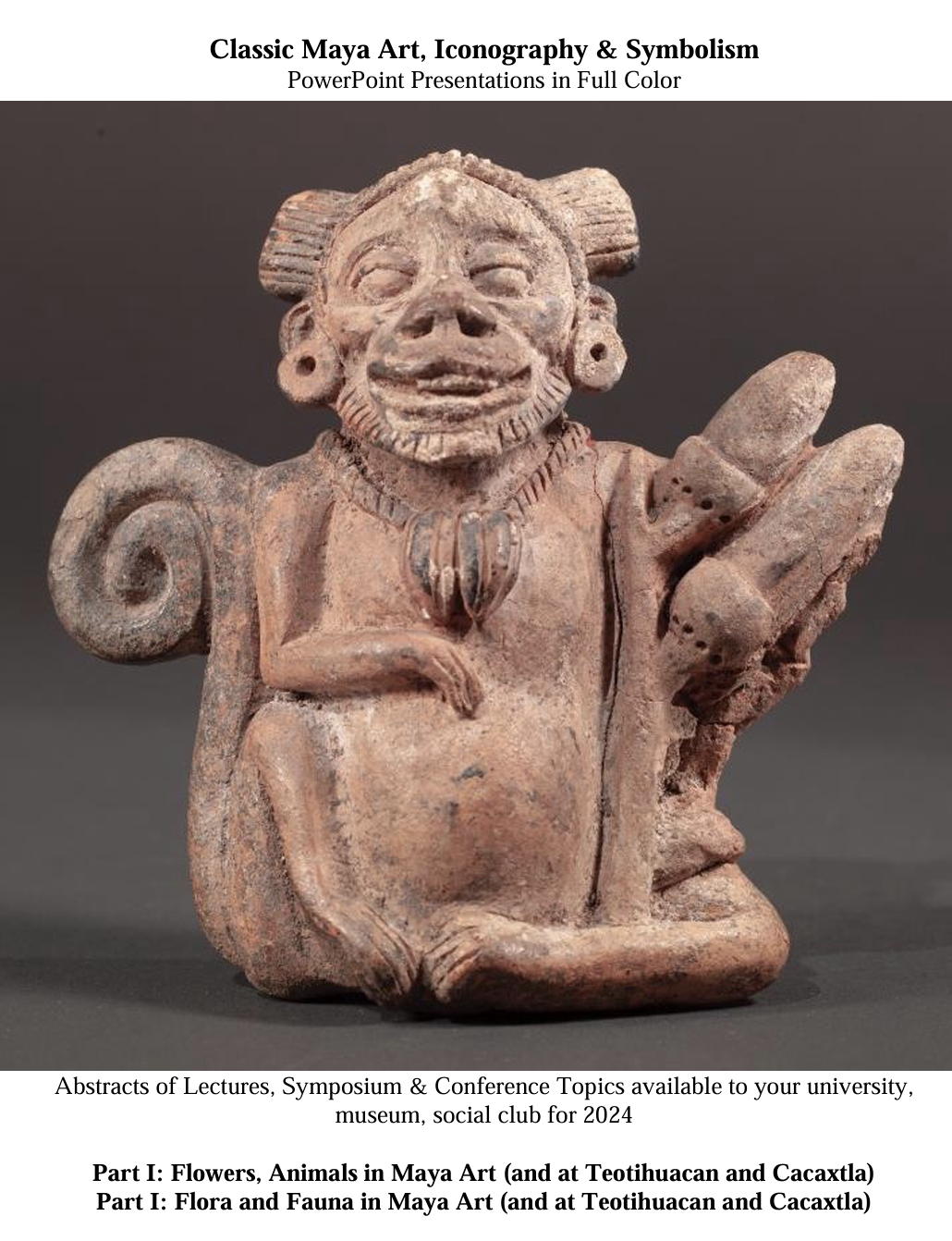
This is "Santa Nicholas" being pulled by native deer of Guatemala. In Classic Maya art deer are associated with monkeys. And paintings of monkeys often show them with deer antlers and deer ears. We have four volumes to release in 2025 from our 2024 research on the iconography of deer in Maya art plus a monumental volume on iconography of monkeys.
The circular path is the Maya Sky Band with celestial motifs. We have published many PDFs on this topic. Just Google Sky Band Hellmuth FLAAR.
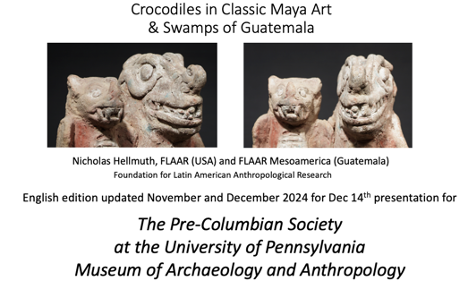
Often the Sky Band is the body of a Bicephalic Cosmic Monster, with "starry-eyed" deer at the left and an upside-down Quadripartite Badge Headdress monster at the right. Just Google Bicephalic Cosmic Monster, crocodile lecture, Hellmuth and you will see lots of Maya art with this monster. We have six chapters of our lecture on iconography of crocodiles in Maya art for The Pre-Columbian Society, University of Pennsylvania Museum. Peccary are not shown in this Christmas card, but our research results on iconography of peccary in Maya art are already published--just Google peccary, Maya iconography, Hellmuth.
The setting features palm trees since that will be our focus for the RBM area of Peten in 2025: which palms have edible parts for the Classic Maya and which palms were used as thatch and walls. In recent years for our CONAP project of the RBM we have studied tasiste palms as an indicator of savannas in PNYNN. Tasiste palm, nance trees, and calabash trees (Crescentia cujete) tend to grow in the Savanna East of Nakum and the Savanna West of Naranjo Sa’al. We have also studied the Savanna of 3 Fern Species and lots of tasistal areas in the RBM and on the west side of Arroyo Petexbatun, upstream from Rio la Pasion, Sayaxche.
Iconography of Crocodiles in Classic Maya Art: Stelae and Ceramics
Posted December 17, 2024
by Nicholas Hellmuth
Crocodile iconography was a December 14, 2024 lecture for The Pre-Columbian Society at the University of Pennsylvania Museum of Archaeology and Anthropology. This is an update and in English for the lecture given in Spanish for the Museo Popol Vuh, Universidad Francisco Marroquin, July 2023.
FLAAR has many lecture topics available for your museum, your classroom, or your society or organization, in-person or via zoom. These lectures are available in Spanish or in English.
 |






If you wish to donate your library on pre-Columbian Mesoamerica and related topics, FLAAR will be glad to receive your library and find a good home for it. Contact:
ReaderService@FLAAR.org
MAYA EPIGRAPHY
Cacao (cocoa) & Flavorings
MAYA AGRICULTURE
Bats
Ancient Maya Rubber Ballgame
Maya Iconography
FLAAR Photo Archives
MAYAN SOCIETIES, ORGANIZATIONS
PNYNN (Yaxha)
CHOLTI-LACANDON
DYE COLORANTS from MAYA PLANTS
FOODS OF THE MAYA ROOT CROPS
Mayan Ethnobotany
BIRDS in Mayan Archaeology
Maya Ethnozoology
Mayan Linguistics
MAYAN MUSIC
Q’eqchi’-Spanish-English Dictionary Segments
MAYA FOOD, DIET
CAVES of the Maya World
2012 Prophecies of the end Mayan calendar
3D Scanning Equipment Reviews For Field Work
Bibliography Mayan dye colorants
GigaPan Epic Pro System
Municipio de Livingston Izabal: places to visit
TECHNOLOGY for Archaeologists, Anthropologists, Zoologists, Botanists, Geologists
TECHNOLOGY, BOOK REVIEWS on Digital Imaging, especially 3D
Antigua Guatemala
Ixchel
Cotzumalguapa
Popol Vuh
Suchitepequez
Uaxactun
Agriculture, diet, food
Maya Vase Rollouts
Maya Archaeology Sites
FLAAR Mesoamerica
Geology: Minerals & Stones of Mayan areas
Zoological Parks
Parks
Maya Archaeology
Maya Architecture
Maya ethnohistory
Glossary
Trees of Mesoamerica
Mayan languages of Guatemala
Copan
Carlos Pellicer, Tabasco
Textiles
Book Reviews
Education
SYMPOSIUMS Congresses Lectures
DIGITAL CAMERAS for Photographing Research
Lectures on Maya topics Now available
Scanners
Antigua Guatemala
Peten (Tikal, Flores)
Atitlan
Guatemala City
Chichicastenango
Baja Verapaz
Copan Honduras
Archaeology of Iran


Follow us |

|
|||
 |
 |
 |
Use of this website signifies your agreement to the Terms of Use. Any problem with this site please report it to webmaster@flaar.org, or if you note any error, omission, or have a different opinion on a review, please contact the editor |
|