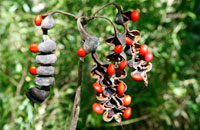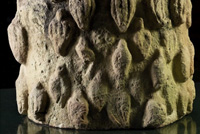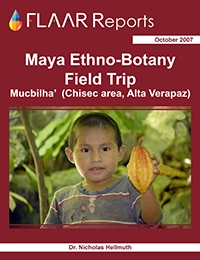
FLAAR is interested in all plants that appear in Maya murals, on ceramics, on sculpture, and are mentioned in the Popol Vuh. For example, a pertinent plant mentioned in the Popol Vuh is Tzite, palo de pito, Its red seeds are still used by the Quiche Maya for divination still today. We found this tree in the Mucbilha community fields and orchards (near Chisec, Alta Verapaz, Guatemala, far from Quiche territory). In fact it was a tree common in the area where they had recently placed vanilla vines.
We are also studying general utilitarian plants. We have a basic interest in medicinal plants but so much of that has already been studied, that we concentrate more on trees, vines, and thatch trees used in making the indigenous houses, for example, or plants that were crucial for diet, or plants for dye (dyeing food such as with achiote, or dying textiles such as with palo de tinto).
Also, practically every plant in the forest and fields had medicinal use for the Maya shamans and curers, so these thousands of species would require substantial grant funding and additional staff. So we prefer to be more realistic, and concentrate on plants such as agave, amate, balche, cacao, cashew, ceiba, copal, croton, flor de mayo (key flower for Lacandon maya), hule, jicaro and morro, nance, papaya, palo jiote, etc.
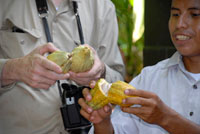
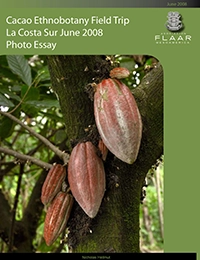
We are especially interested in cacao species
FLAAR has been studying pataxte for several years (after first seeing it perhaps a decade earlier at Takalik Abaj and of course reading about pataxte in the Popol Vuh decades before we found the actual trees).
During 2014 we went to many diverse eco-systems in Guatemala with this Theobroma bicolor.
Next we began to study Theobroma angustifolium. It took several weeks to find this and we had a thousand kilometer round trip drive to get to the cacao silvestri location.