Unexpected extensive grassland Savanna discovered east of Nakum
Posted March 03, 2019
During February’s second week, the FLAAR Mesoamerica team went back to Parque Nacional Yaxha Nakum Naranjo, with the goal to keep photographing and studying the flora and fauna of this impressive park. From analyzing aerial photographs (Instituto Geografico Nacional) the week before the field trip, Nicholas had noted a large area (over a square kilometer) with almost no trees. But it was natural (in other words, the trees were not missing because squatters had chopped them down).
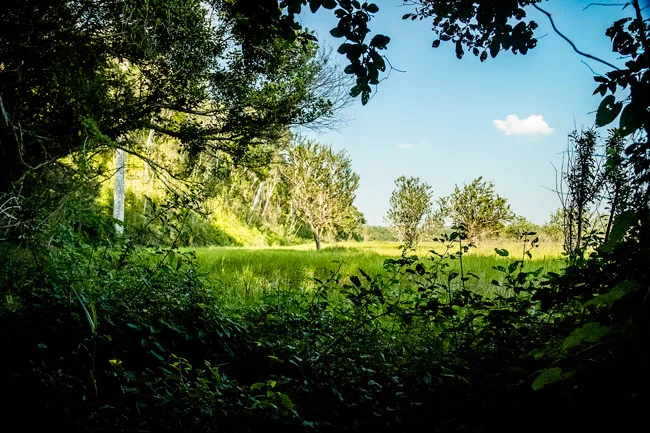
Lots of plants out there: but only specific kinds that survive a savanna ecosystem: so far we have found calabash trees and palmetto palms; we expect to find nance trees when we can return to dedicate more time. Our initial goal was to make this unprecedented discovery of a pristine savanna: not a Belize savanna; not a Poptun savanna; not a La Libertad or south-of-Lake-Petén-Itza-savanna: this is a savanna of Parque Nacional Yaxha Nakum Naranjo, a park administered by IDAEN + CONAP and with help of the park rangers.
Lots of Mayan mounds buried under trees and vines on the hill overlooking the savanna.
Taken with a Canon EOS-1D X Mark II camera; lens is a Canon EF 24-105mm f/4.0 L IS USM; settings: f/4, speed 1/8000, ISO 10000. Photo by Alejandra Gutiérrez, February 18, 2019.
With the help of the IDAEH-CONAP team the FLAAR Mesoamerica researchers were able to follow a narrow trail through the rain forest to hike 5 to 6 km from Nakum. What we found is known as “La Sabana” by the park rangers. We are calling it “East-of-Nakum-Savanna” to help people find it on Google maps and the maps of the Instituto Geografico Nacional. On the printed maps it is shown with the symbols that document an occasionally wet savanna (it would be wet in a really rainy year; 2018 was a dry year so in February it was rather dry, yet you note from the photo that everything is green).
It is crucial to learn about every single different eco-system in PNYNN because if LiDAR suggests there were “millions of Mayan people” then how did this large population utilize the savannas and bajo ecosystems? Our goal is to find all the various ecosystems, describe them, and document their potential for further research by universities and research institutes.