Potential for using drones
Posted Jan 19, 2015
Twenty years ago archaeologists used balloons to do “aerial photography” of their digs. Photographs from helicopters over 30 years ago by Nicholas Hellmuth have attracted many people from around the world to visit Tikal (since our photos are in several popular books on the Maya). So aerial photographs help scholars, and help Guatemala attract investment in tourism (which provides jobs to local people). But nowadays, balloons are passé; and helicopters have always been too expensive: today drones are available.
Drones were the feature of Photokina 2014 trade show in Cologne, and drones were more news at CES 2015 in Las Vegas. Since the FLAAR team is a prime consultant for SGI trade show in Dubai (same week as CES in USA) we had to skip CES, but three of us inspected several brands of drones at Photokina a few months ago in Cologne, Germany.
We are not employing drones at any archaeological site, but we publish this note to encourage scholars to study drone technology. We will be glad to assist in training any project staff members (since we attend the technology expositions where drones are available to study).
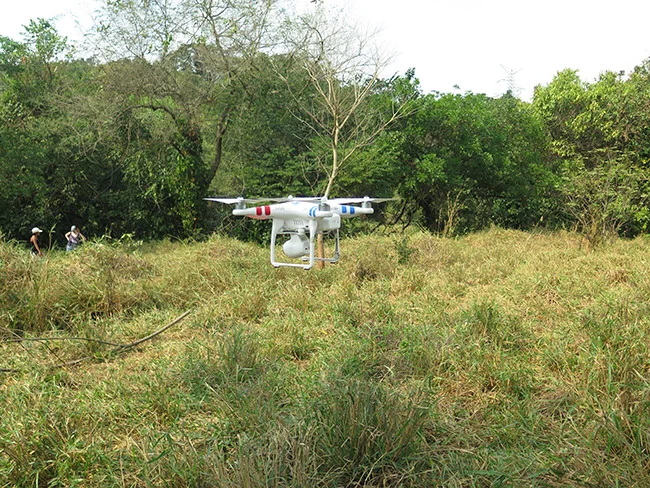
Presently we are learning about drones by employing them to study flowers high in trees. It would take a 600mm or 800mm prime telephoto lens to capture images of flowers in a tall tree. These lenses cost about $12,000 and up (so no surprise, until a kind benefactor assists by a donation, we do not have even a 400mm or 500mm lens).
We learned a lot this weekend by using drones to photograph two ceiba trees and two palo gordo trees (all in the Costa Sur area of Guatemala). The first important experience is that the normal kind of camera, GoPro and various clones, is great for hiking, biking, and family use, but has too much circular distortion for scientific use by botanists or archaeologists.
Our goal is to write up a list of suggestions of which drone brands, and which kinds of cameras and lenses would be best for archaeologists in Guatemala, Mexico, Honduras, and all the rest of Mesoamerica. By publishing our trial-and-error test results we can save archaeology projects a lot of time and money (so you don’t acquire equipment which will not be adequate for a scientific project).
If you wish an experienced drone pilot in Guatemala, we recommend Juan Carlos Fernandez.