Panorama photography equipment for archaeology & architectural history
Posted December 27, 2018
Our project at Parque Nacional Yaxha Nakum Naranjo is to make annotated lists of waterbirds, other birds, mammals, etc, and also all edible and utilitarian plants usable by the Classic Mayan people 2000 years ago. Plus to show the entire world the majesty of the Neotropical rain forests, lakes, rivers, and lowland areas around Yaxha, Nakum, Naranjo, and Topoxte Island.
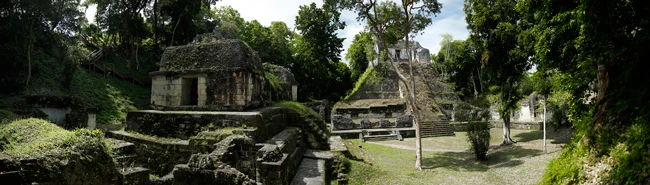
Here is a view inside the main acropolis at Nakum: lots of temples, lots of pyramids, and palaces lining several levels of the pyramids.
If you want to see lots more monumental acropolises, multi-storied palaces, and endless number of throne rooms in these palaces, be sure to try to get to Naranjo (walkable from Yaxha if you have time and strength for about 20km hike in and 20km hike out) or (high axel 4WD-drivable from Melchor de Mencos (border town facing Belize).
For documenting the majesty of the jungle as well as for showcasing the pyramids, temples, palaces, and acropolises, panorama photographs are very helpful.
Although our present focus is on plants, animals, and the diversity of eco-systems, the park administration team has asked that since we have high-resolution camera equipment, that it would help if we also do panos of some of the pyramid-temples, palaces, etc. So in November Maria Alejandra Gutierrez (FLAAR Mesoamerica) began using our GigaPan digital system in Grupo Maler. And in December she returned along with Roxana Leal and Sebastian Molina (also FLAAR) to do additional panoramas, including of Topoxte Island (since this was one of the requests by the park).
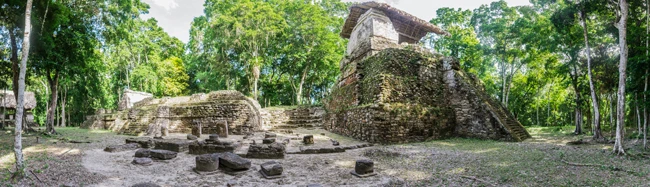
Panorama view of one part of the Post Classic Mayan temples of Topoxte Island, Lake Yaxha (Parque Nacional Yaxha Nakum Naranjo). The late structures here have features comparable to Chichen Itza and Mayapan, of Yucatan.
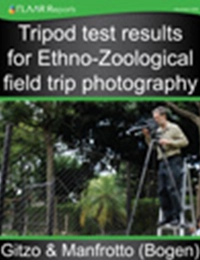
Gradually we will be adding additional panorama equipment and exploring the virtual reality applications. But to start with we continue to use the GigaPan and the L-shaped accessory by Bogen 3288 (Manfrotto 340) on top of a Manfrotto 303PLUS panoramic photography tripod head. An L-shaped accessory allows you to easily take a higher panorama (since if your camera is only horizontal you need a wide-angle lens, which distorts the subject). If you have an L-shaped tripod head (on a panorama tripod head) then you can attach your camera vertically and get much higher resolution with noticeably less distortion.
We will also be doing panoramas “inside the jungle” surrounding the ruins, especially the corozo palm eco-system, the Aechmea magdalenae eco-system, the native Guadua bamboo eco-system (along Rio Holmul) and all the other eco-systems around the park.