Further research on Maya archaeology for 2013
Posted Dec. 26, 2012
The Maya people throughout Guatemala, Mexico, Belize, and portions of Honduras and El Salvador still practice their Mayan languages and their culture. While in the Lake Atitlan region of Highland Guatemala for studying native dye plants during Christmas week, all our questions had to be translated into Tzotzil Mayan.
The list of non-chemical dyes which we received, and the lists from almost all published reports, include onions, carrots, and beets (and banana as a mordant to fix the color). Our interest is to find the original indigenous pre-Columbian dye plants. An added benefit of having 100% non-Eurasian plants is to increase tourism, as tourists are interested in learning about plants which the actual Mayan speakers would have used a thousand years ago. Actually most of these plants still grow in Mesoamerica today.
Another major goal is to complete our list of prehispanic fruits and nuts. Our emphasis is to improve local nutricion.
We are also studying all the plants other than tobacco which were used to smoke. Tobacco may be the best known, but the Maya (and Aztec) used almost a dozen other local plants as flavorings. And the cigars were wrapped in nance leaves (not always in tobacco leaves!). I first leaned about Maya cigars at age 19, while a student at Harvard, working on the Tikal Project of the University of Pennsylvania. One of the vases in the early 9th century A. D. royal tomb which I discovered pictured a man, with very happy expression on his face, smoking a cigar.
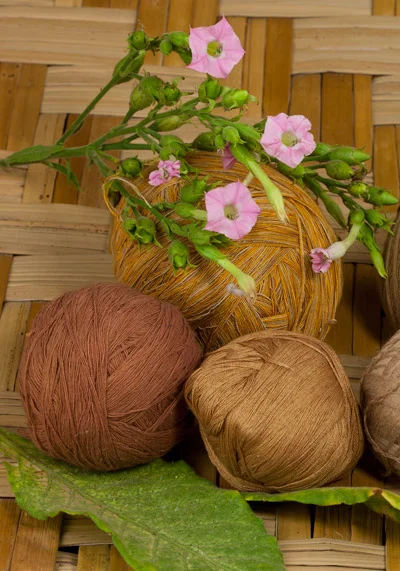
Tobacco flowers and local cotton dyed with various other native plants. Tobacco flowers are attractive garden plants and tobacco provides a good dye for cotton. San Juan la Laguna, Lake Atitlan, Guatemala, photograph by Nicholas Hellmuth.
Plus tobacco is one of the dye plants. Additionally tobacco flowers are great for your garden. I raise two species, white-flowered and light-red flowered. We are seeking other native Nicotiana species and colors as well.