Did the Maya use Lichen and Mushrooms as a source of dye colorants?
Updated April 3, 2019,
first posted March 19, 2019
The Parque Nacional Yaxha Nakum Naranjo administrators realized that the park has a lot more than monumental architecture, so the FLAAR Mesoamerica team is working together with the park administrators to find all edible plants and all usable plants (and lichens and mushrooms, which technically are different than “plants”).
One discovery of the FLAAR research team is that several mushrooms and at least one lichen can produce viable dye colorants. Turns out that one of these mushrooms is the most common large mushroom in the park. Elena Siekavizza, plant researcher at FLAAR Mesoamerica, found 48 Peten-area mushrooms that can produce dye colorants. Of these we have already located about a dozen at the Yaxha park.
So there really is a lot to see, experience, and learn about at the park (in addition to pyramids, palaces, temples, acropolises, plazas, and causeways). The FLAAR team has found 20 species of lichen which provide colorants that potentially can be found at Yaxha. It would help if an individual or foundation or company could donate a good pair of binoculars and a quality digiscope so we can find and then photograph these lichens. Whereas most mushrooms are on the ground, many lichens are high up in the treetops. If you can donate the binoculars and a Swarovski or Zeiss digiscope with connectors to one of our cameras (we have both Nikon D5 and Canon EOS 1DX Mark II) you can accompany a future field trip (you, your family, friends). This equipment is also helpful for studying orchids, bromeliads, and birds of the Neotropical rain forests. Or if you can’t get to the park, you can fly Dr Hellmuth to give a lecture in your hometown anywhere in the world: at a local museum, local university, local social club, at your company, etc. Contact: frontdesk symbol FLAAR.org We assume you know how to create a viable e-mail from this.
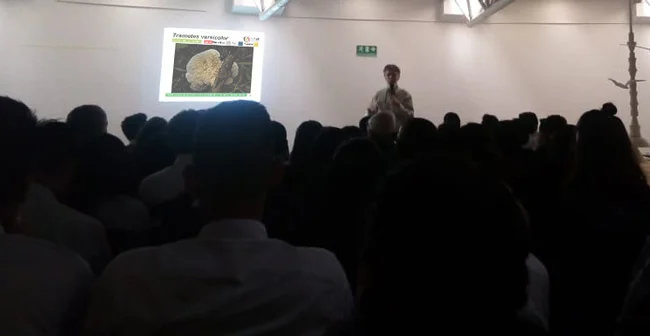
Dr Hellmuth presented the discoveries of which species can produce dye colorants on April 2, 2019, 10 am (to 11 am), Museo Ixchel on campus of UFM, Zona 10, Guatemala City. The lecture shows lots of the trees and plants at Yaxha which can produce colorants (including trees not yet in any book on Mayan colorants of Guatemala).
If you are in another part of the world, the FLAAR team has lots of potential lecture topics for your university, museum, or organization. This lecture is available in English, Spanish, German, or your simultaneously translated language of preference.