Q’eqchi’ Mayan words for mammals
Most recently update April 20, 2016.
Updated November 20, 2015.
Updated January 21, 2015.
First posted Jan. 5, 2015 To prepare for the new year 2015 with more information on Mayan languages to assist all Maya research scholars and students.
This list of Q’eqchi’ Mayan words for mammals is based on work by Luz Maria Caal and Pedro Chub Choc , both of Senahu, Alta Verapaz. They had available three standard Q’eqchi’ dictionaries, but the word list is based on their own knowledge of the Q’eqchi’ Mayan language and their own knowledge of animals.
In our reference library we also have the K’ekchi’ dictionary of Guillermo Sedat, plus permission of his son, archaeologist David Sedat, to use the dictionary as a source. We will update this page with a comparative tabulation of all readily available Q’eqchi’ dictionaries in the future.
The list here also includes some animals from Africa that you see in zoos (even in Guatemala) and of course you see animals of Africa in movies (such as Madagascar).
Animals are helpful for epigraphers, iconographers, zooarchaeology
Knowledge of animals is helpful to Mayan languages, archaeology, epigraphy, and iconography. So we have a long-range goal to make this information easier to access. It takes a long time to find a diccionario, and figure out what animals to look for. So we try to get a lot of this time-work done for you in advance.
The list which follows is a first stage. We have no funding so this is not a formal project. Part is to help myself learn as many Q’eqchi’ Mayan words as possible. The rest is to help zoologists, zooarchaeologists, and all the other scholars and students plus lay people who would like to exercise their brain so it does not atrophy.
We marked in bold font animals which are native or (in the case of dogs) which existed in close species before the Spanish species wiped out the local DNA (on this subject, native barkless, relatively hairless dogs did exist in the Q’eqchi’ areas of Guatemala until two years ago. We have spoken with two people who saw them 20 years ago. We went there (10 hour hike into the mountains) but the local people said the last one died 2 years ago. This is all the more reason to work now, since in a few more years not much of the original Maya eco-system will remain.
African palm oil plantations bulldoze entire areas (but we all use the products which result). Teak plantations bulldoze even more. Mines for minerals take down entire hills (after all, we all need metal). Brazil rubber plantations obliterate what is left (cars and trucks need to have tires). And sadly, milpas wipe out even more natural forest (but at least they are subsistence farmers).
For example:
|
Q´EQCHI´ |
ESPAÑOL |
ENGLISH |
ZOOLOGICAL NAME |
What is left is obliterated for cattle haciendas (most of us pig-out on hamburgers or steaks).
So we are doing our best (even though we have no grants and no private donations (yet, we would certainly appreciate funding, write FrontDesk “at” FLAAR.org), to provide information on our diverse network: www.maya-ethnozoology.org, www.maya-ethnobotany.org, www.digital-photography.org, and www.maya-archaeology.org.
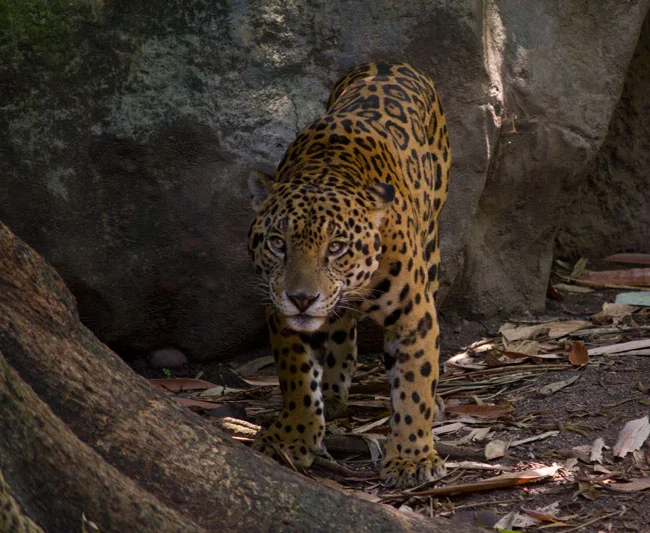
NOTE: in local Spanish language, especially in Chiapas, Peten, Campeche, etc. the word “tigre” usually means jaguar. And the world “leon” usually refers to the local puma (mountain lion). The local Mayan people are not referring to the animals of Africa. It was the invading Spaniards who started the use of the incorrect words.
The same problem is with the brocket deer. This is not “venado.” Venado is the word for the white-tailed deer (Virginia deer, which is fully native here in Guatemala albeit a tad smaller than the ones in North America). The word for brocket deer in rural areas of Central America is cabro (otherwise the word for goat).
I also suspect that the Mayan word for “leopard” may actually refer to a local feline and not necessarily always to a leopard from Africa. We need to check with Q’eqchi’ speakers to get a full list of words for ocelot and margay and jaguarondi. There are five felines native to the Mayan areas. The wild cat is not present in the Classic Maya areas.
MAMIFEROS in Q’eqchi Mayan – MAMMALS
|
Q´EQCHI´ |
ESPAÑOL |
ENGLISH |
ZOOLOGICAL NAME |
| AAQ | Pecari | Peccary | Tayassu tajacu |
| AAQAM | Cotuza | Cotuza | Dasyprocta punctata |
| AJ B´OOX UCH | Tacuazin negro | Black Tacuazin | Didelphys marsupialis |
| AJ RUP KUK | Ardilla voladora | Flying Squirrel | Glaucomys volans |
| AJ YOO | Perro cazador | Hunting dog | |
| AYINKAAQ | Dinosaurio | Dinosaur | |
| B´A | Taltuza | Taltuza | Othogeomys grandis |
| B´ALAK´ XUL | Cebra | Zebra | Equus quagga |
| B´ALAM | Jaguar | Jaguar | Panthera onca |
| B´AQXUL | Armadillo | Armadillo | Dasypus novemcinctus |
| B´ATZ | Mico | Spider monkey | Ateles geoffroyi |
| B´OOYX | Buey | Ox | Bos primigenius taurus |
| CHAJAL KUK | Ardilla Gris | Gray Squirrel | Sciurus aureogaster |
| CH´EM SAMXUL | Elefante | Elephant | Loxodanta africana |
| CH´O | Ratón-Rata | Mouse, rat | |
| CHIB´AAT | Cabra | goat or broket deer | Capra aegagrus |
| CHO´HIX | Leopardo | Leopard | Panthera pardus |
| HALAW | Tepezcuintle | Agouti | Cuniculus [Agouti] paca |
| HIX | Tigre | Jaguar is the correct translation, NOT tiger. | Felis onca |
| IB´OY KAAN | Cochinillo | Armadillo | Cabassous centralis |
| IMUL | Conejo | Rabbit, unlikely a hare in Guatemala | Sylvilagus brasiliensis Sylvilagus floridanus |
| JILIX KAWAAY | Cebra | Zebra | |
| K´AMB´OLAY | Tigrillo | feline | Potentially ocelot |
| K´ICHE´ AAQ | Coche monte | Peccary | Tayassu tajacu |
| K´ICHE´CHO´ | Lirón | Mouse | Heteromys desmarestianus |
| K´UNUCH IMUL | Canguro | kangaroo | Macropus rufus |
| K’AX LAN UCH | Tacuazin cazador de pollitos | Tacuazin | Tlacuatzin canescens |
| KAQKOJ | León | Puma, mountain lion | Felis concolor |
| KARNEER | Carnero | Bighorn sheep | Ovis canadensis |
| KAX AAQ | Hipopótamo | Hippopotamus | Hippopotamus amphibius |
| KAXCHIXL | Rinoceronte | Rhinoceros | Rhinoceros sondaicus |
| KAXLAN YUK | Macho Cabra | Red Brocket | Mazama americana |
| KAXMIS | Marmota | Marmot | Cynomys ludovicianus |
| KEJ | Venado | White-tailed deer | Odocoileus virginianus |
| K’IX UCH | Puercoespin (Tacuazin con espinas) | Porcupine | Coendu mexicanus |
| KUK | Ardilla | Squirrel | Sciurus spp., |
| KUY, -AAQ | Marrano | Pig | Sus scrofa domestica |
| MAMA´AYIN | Cocodrilo | Crocodile | Crocodylus acutus Crocodylus fuscus Crocodylus moreletti |
| MAMA´MAX | Gorila | gorilla | Gorila beringei |
| MAX | Mono | Howler monkey | Alouatta palliate Alouatta pigra |
| MIS | Gato | Domestic cat | Felis silvestris catus |
| MUUL | Mula | Mule | Mula |
| OW | Mapache | Raccoon | Procyon lotor |
| PAAR XUL | Zorrillo | Skunk | Mephitis macroura |
| PAKUNWAKAX | Buey | Ox | |
| RAL CHIB´AAT | Chivo | Baby coat | Capra aegagrus |
| RAL WAKAX | Becerro | Bull calf | Bos primigenius taurus |
| RUPKUK | Ardilla voladora | Flying squirrel | Glaucomys volans |
| SAQ B´ALAM | Tigrillo | Leopardus weidii | |
| SAQ’I UCH | Tacuazin blanco | White Tacuazin | Didelphis virginiana |
| SAQB´IN | Comadreja | Mustela frenata | |
| SIS | Pizote | Pisote | Nasua narica |
| SOTZ´ | Murciélago | Bat | Desmodus rotundus Artibeus jamaicensis |
| T´INITZ | Caballo | Horse | Equs ferus |
| TIS (Wilson) | Danta, tapir | Tapir | Tapirus bairdii |
| TZ´UQTZUN | Oso hormiguero | Anteater | Tamandua mexicana Myrmecophaga tridactyla |
| TZ´UQXULEB´ | Moth, possibly toxic | ||
| TZI´ | Perro | Domestic dog | Canis familiaris |
| TZI´K´ICHE´—XOJ | Lobo | Wolf | Canis lupus |
| UCH | Tacuazín | Opossum | Didelphys marsupialis |
| WAKAX | Vaca | Cow | Bos primigenius taurus |
| WON XUL | Oso | Bear | Ursus americanus |
| WOYO´ | Cabeza de viejo | Eira barbara | |
| XOJB´ TZ´I PIM | Coyote | Coyote | Canis latrans |
| XUL IIQANEL | Burro | Donkey | Equus africanus asinus |
| YA´K´ACHKEJ | Jirafa | giraffe | Giraffa camelopardalis |
| YAK | Gato de monte | Lynx | Lynx rufus |
| YUK | Hembra cabra | Goat (Wichmann and Hull, p.21) | Mazama americana |
Acknowledgements
This tabulation is the work of several helpful individuals from Q’eqchi’ Mayan villages: Luz Maria did the first draft. Pedro helped Nicholas understand some of his questions. Both these individuals are native Q’eqchi’ Mayan speakers from Alta Verapaz (who assist us at FLAAR Mesoamerica to understand local words).
Nicholas edited the translations since, having lived in Guatemala for over 50 years, he is well aware that the word tigre and leon can also mean jaguar and mountain lion (if the Spanish is local lingo).
We have a bibliography on Q’eqchi’ diccionaries and vocabularios
We have a separate web site in the FLAAR network where we have all our bibliographies, www.maya-art-books.org. In this web site we have a page listing the best known diccionaries and vocabularios of Q’eqchi’ and K’eqchi’ Mayan language.