Fish on Copan Altar O, Copan Stela N, Copan Altar T and other sculptures
First posted February 19, 2024
Sculptures of Kaminaljuyu (Guatemala City, in MUNAE) have several large fish, including an isolated one. The fish on sculptures of Copan, Honduras, have not been singled out to study, so I wish to show the largest fish and several of the others.
A full-figure fish hieroglyph from Str. 10L-22A, the Mat House, is pictured on page 132 of William Fash’s 2001 updated edition of SCRIBES, WARRIORS and KINGS, The City of Copan and the Ancient Maya.
A complete fish sculpture from a cache under Structure 32 is pictured on page 144 of Barbara Fash’s 2011 COPAN SCULPTURE MUSEUM: Ancient Maya Artistry in Stucco and Stone.
But the largest fish, the ones that have not been featured in any book on iconography of Copan, are on Altar O. During a conference at the Museo Popol Vuh, Universidad Francisco Marroquin, July 2023, there were two conferences that discussed fish in Classic Maya art. I am curious whether they mentioned the fish of Copan. But to help iconographers and ethnozoologists, we now show several of the fish at Copan. Altar O and Stela N are outside in the plaza area. The fish being eaten by the pelican is in the Copan Sculpture Museum.
The fish at Copan are most probably fresh water fish. Marine fish, especially sharks, are shown in Olmec art and Maya vase scenes of Peten.
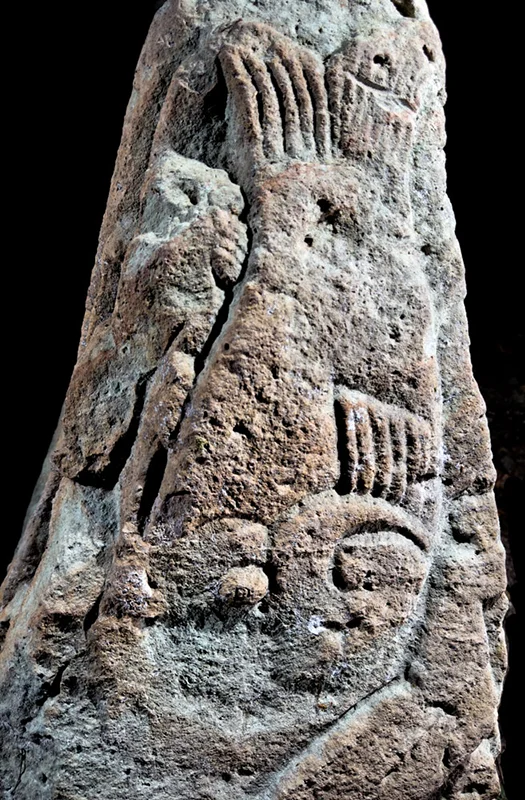
The figure on the left side of the fish needs to be identified. This scene needs in depth research on that part.
Since the Rio Copan flows behind the ruins of Copan there would have been plenty of freshwater fish as models for the large fish. The Bufo Toad often hops along a river side and swims a bit into the water (it’s more a land toad than a river frog, but it does swim).
In order to see the fish, you need to position your portable studio lights carefully to bring out detail. The FLAAR team has decades of experience in cross-lighting to help reveal details for iconographic study. It is sad that most photos in archaeology reports are just snapshots, with no lighting to show the subject.
In the Central Peten Lowlands, most full-figure fish hieroglyphs are in the PSS, Primary Standard Sequence, and are for the ancient Maya word for what is called cacao today. So far there is no suggestion of a cacao reference for the fish sculptures at Copan; none are associated with a Primary Standard Sequence, which would be on a vase, bowl, or plate.
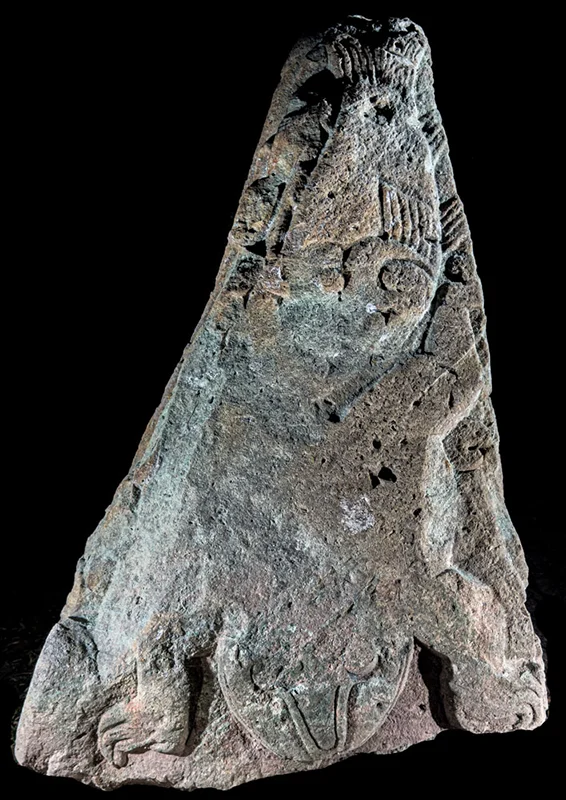
I have no idea why this fish is diving “into” the tail end of the Bufo Toad (Rhinella marina, formerly named Bufo marinus). The poison sac of this toad is near each ear, not the tail end.
Photograph by Nicholas Hellmuth, February 5, 2024, 8:05 pm in the evening with a Honda portable electric generator to power several different kinds of portable photo studio lighting. When you need to do hundreds of photos nowadays it’s a lot easier to use an iPhone 15 Pro Max. We have Nikon, Canon, and Sony cameras, plus tripods, but the iPhone processes the photo while it’s taking it so not much Photoshop is required. We shoot in RAW (DNG) format with the iPhone.
The most noticeable fish at Copan is in the Copan Sculpture Museum
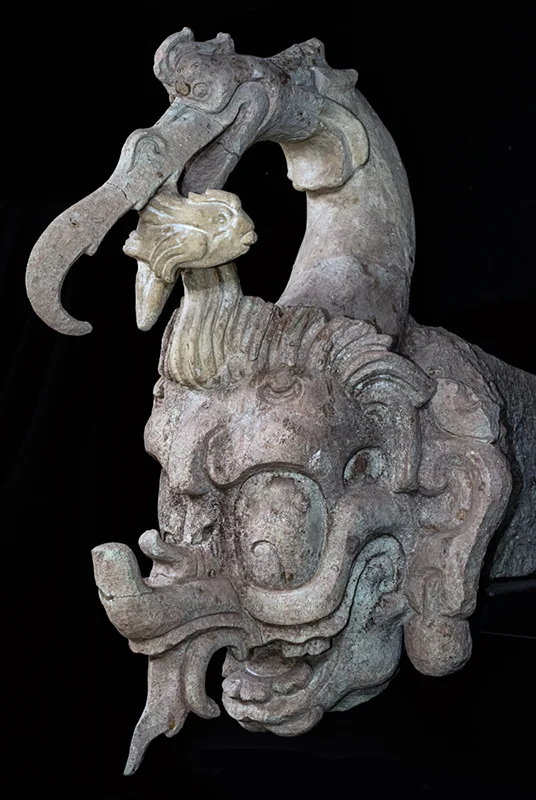
We are preparing an entire FLAAR Reports on this circa 2-foot high stone sculpture in the Copan Sculpture Museum. A male white pelican, Pelecanus erythrorhynchos is getting ready to flip this fish down his hungry throat. We know it is a white pelican and not the other common pelican species in the Maya areas because the sculpture had a raised area in the top middle of the beak. This raised area does not occur in brown pelicans, Pelecanus occidentalis. This raised semi-circle occurs only in the mating season of the male white pelican. If you want to do Maya iconography, it helps to study waterbirds up-close and in-person.
Lots of Fish any time there is a water lily flower on a stelae
Stelae of Machaquila, Peten, Guatemala, have lots of water lily flowers with fish nibbling on them, but these stelae were not known in 1913 when Herbert Spinden showed illustrations of fish. You can see the Machaquila stelae in MUNAE, Guatemala City (the museum reopened in autumn 2023). Copan Stela N is the Copan equivalent of Machaquila stelae.
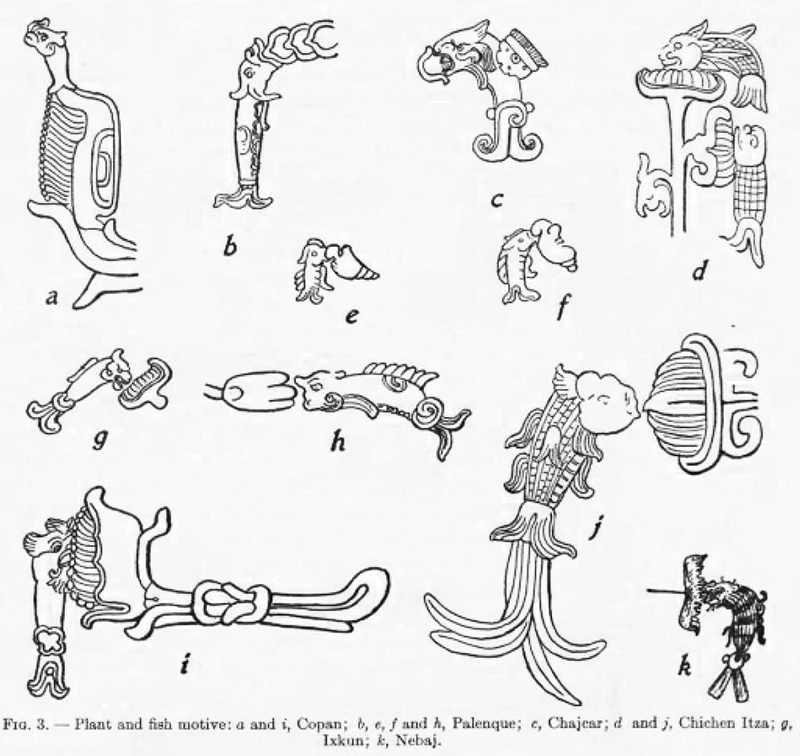
Other than full-figure fish in the PSSequence on vases and bowls, the most common place to find fish in Maya art is nibbling on water lily flowers (actually they are after the seeds inside but the Maya artist shows the water lily in full-flowering mode, not wilted when the seeds are available inside). Spinden 1913: Figure 3. “a” is Copan Altar T. “i” is probably Copan Stela N. On our next field trip to Copan (probably March 2024) we will photograph the water lily flower and fish of Copan Stela N, and do a close-up of the fish on Copan Altar T.
SPINDEN, Herbert J.
1913
A Study of Maya Art, Its Subject Matter and Historial Development. Memoirs of the Peabody Museum of American Archaeology and Ethnology, Harvard University, Vol. VI.
This is available as a download, albeit not OCR. Most people use the Dover reprint over half a century later (1975).