Bats and their role in Maya culture
First posted April 17, 2024
Bats are amazing and unique creatures. They have caught humans’ attention since the beginning of time with a mixture of mysterious and amazing features. Fuzzy nocturnal hunters or pollinators, the only flying mammals that also evolved to use ultrasonic waves to help them communicate and fly swiftly through their habitats. From China to Scandinavia, bats can be found almost anywhere in the world, and Mesoamerica isn’t the exception at all. In fact, this is a region where several bat species of all shapes and sizes have thrived since millions of years ago. Living in caves, woodlands, cities and many other habitats, there is no doubt that they would play a part in the different cultures with which they happened to coexist with. But for the Mayas, bats were a lot more than just another species habiting their surroundings; they played a role in their symbolism and religion.
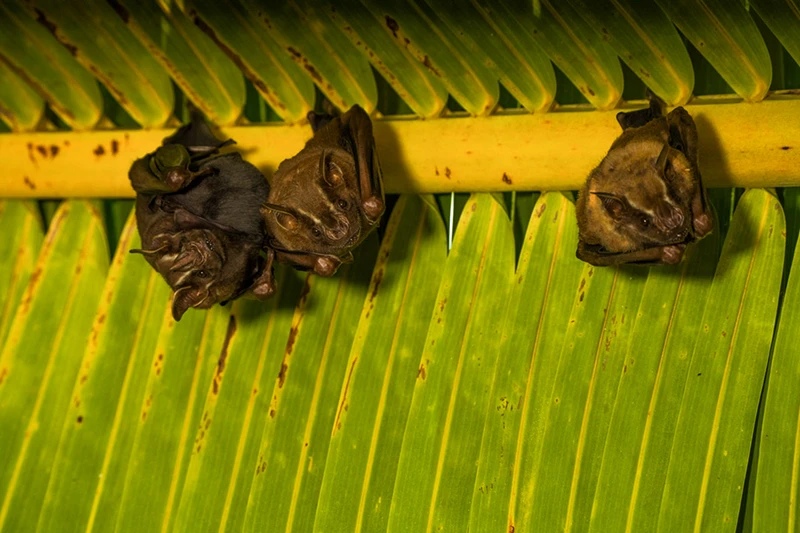
Artibeus lituratus bats in Livingston, Tapon Creek.
Photography by: Maria Alejandra Gutierrez, FLAAR Mesoamerica, May, 2021. Tapón Creek, Livingston, Izabal, Guatemala.
In Maya history and iconography it is common to find bats and humans or other beings with bat-like characteristics. Bats appear playing different roles, for example as messengers (often paired with a bird), associated with fertility and rebirth (probably because of its role in pollination and vegetation), and sometimes as the physical representations of diseases. One of their most popular appearances in Mayan culture is in the Popol Vuh, a sacred Kʼicheʼ narrative which portrays Camazotz, a deity from the underworld. Camazotz is represented as a human with bat attributes that challenges Unahpu and Xbalanque (the main characters of this chapter of the Popol Vuh) to a ball game. Also, during this same narrative the Lords of Xibalba (the underworld) demanded that the Hero Twins survive for a night in the terrible Zotzi Ha, “the House of the Bats”. Some authors believe that this fragment emphasizes the struggle for survival and the importance of wit in overcoming adversity. Ethnozoologists, archaeologists and other researchers believe that the species depicted in this underworld iconography as Camazotz was probably Chrotopterus auritus, commonly known as the big-eared woolly bat. Also, two species of native bats were of cultural importance: leaf-nosed bats (of the Phyllostomidae family) and vampire bats (Desmodus rufus). The most important Maya cities had their own emblem glyphs. The main symbol for Copan was the leaf-nosed bat (you can look for it in the hieroglyphics on stelae).
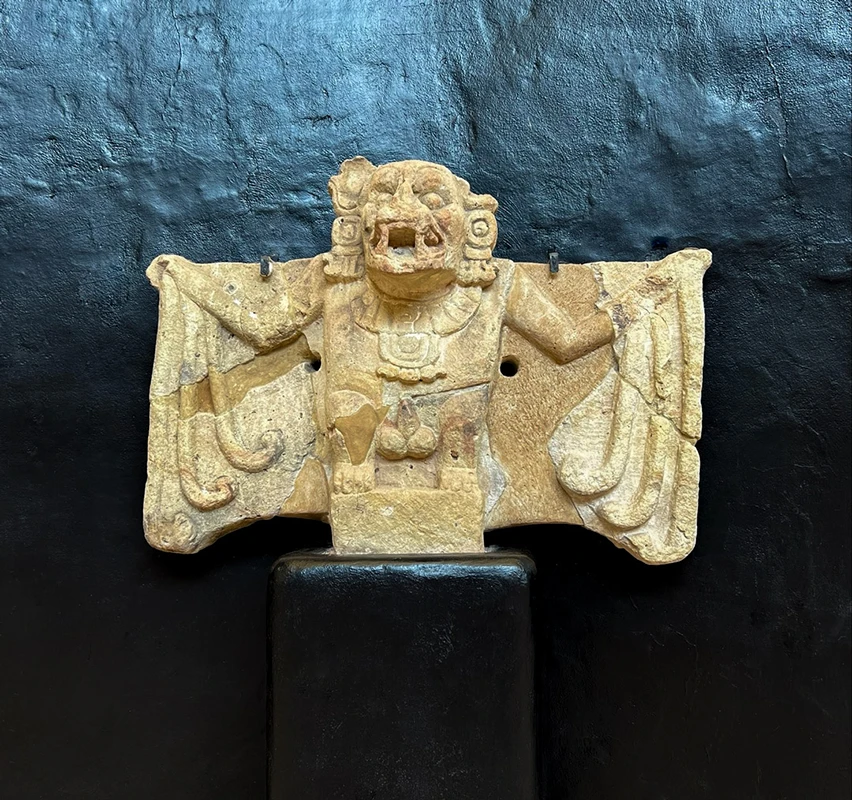
Copan Emblem Glyph in Copan’s Museum of Sculptures.
Photography by: Vivian Hurtado, FLAAR Mesoamerica, Feb. 02, 2024. Museo de Escultura de Copán, Copán, Honduras.
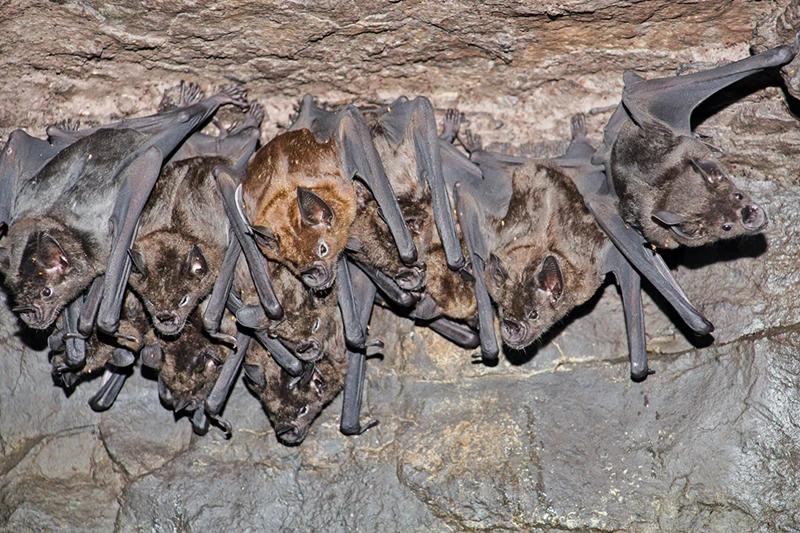
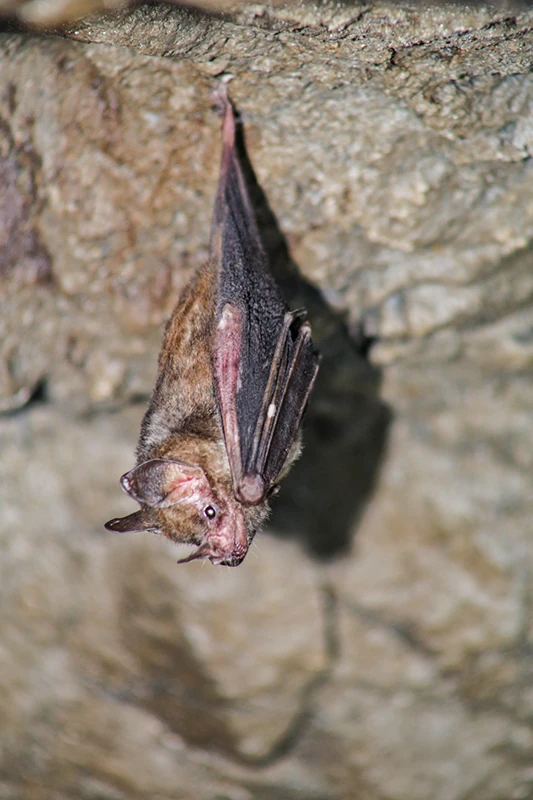
Chrotopterus auritus, false vampire in Orotina, Costa Rica. Photography by: Erick Flores, FLAAR Mesoamerica, Mar. 20, 2017. Orotina, Costa Rica..
References Cited
ALVEZ, D.M., DINIZ-FILHO, J., DA SILVA-SOUZA, K., GOUVEIA, S.F. and VILLALOBOS, F.
2018
Geographic variation in the relationship between large-scale environmental determinants and bat species richness. Basic and Applied Ecology (Print), 27, 1–8.
Available online:
https://doi.org/10.1016/j.baae.2017.12.002
BRADY, J.E. and COLTMAN, J.
2016
Bats and the Camazotz: Correcting a century of Mistaken Identity. Latin American Antiquity, 27(2), 227–237.
Available online:
https://doi.org/10.7183/1045-6635.27.2.227
FISCHER, A.
2022
Murciélago lanudo: ¿qué representó para los mayas? – National Geographic en Español. National Geographic En Español.
Available online:
www.ngenespanol.com/animales/murcielago-lanudo-mitologia-maya/
NÁJERA CORONADO, Martha
2013
Roberto Romero Sandoval, Zotz. El murciélago en la cultura maya. Universidad Autónoma de México, Instituto de Investigaciones Filosóficas.
GUNNELL, G.F. and SIMMONS, N.B
2005
Fossil evidence and the origin of bats. Journal of Mammalian Evolution, 12(1–2), 209–246.
Available online:
https://doi.org/10.1007/s10914-005-6945-2
THOMPSON, J.E.S
1966
Maya Hieroglyphs of the Bat as metaphorgrams. Man (London), 1(2), 176.
Available online:
https://doi.org/10.2307/2796344
UNAM-CEMUK
2011
The bat in the Mesoamerican context. UNAM-United Kingdom.
Available online:
https://unitedkingdom.unam.mx/the-bat-in-the-mesoamerican-context/
U.S. National Park Service
2010
Echolocation in Bats.
Available online:
https://www.nps.gov/subjects/bats/echolocation.html