Mayan foods, Bibliography on Xanthosoma sagittifolium, malanga, edible root crop
First posted, early September, 2017.
Malanga (cocoyam, taro) popular Mayan food
The word malanga is used for Colocasia esculenta and for Xanthosoma sagittifolium. Colocasia esculenta is not native to Mesoamerica whatever. Unfortunately it is the larger Colocasia esculenta roots which are in all the supermarkets.
Malanga roots come in two sizes in Q’eqchi’ Mayan markets
At the biggest two supermarket chains in Guatemala City (Paiz and Supermercado La Torre) you get the really big roots. They are bursting with energy. These appear to be Colocasia esculenta (which is not native to Mesoamerica).
The small roots rotted in less than two weeks. Since it is the middle of the rainy season in the Highlands of Guatemala, a lot of things rot quickly. The larger roots did not rot even when put outside under a roof, but they were quickly infested with some kind of insect.
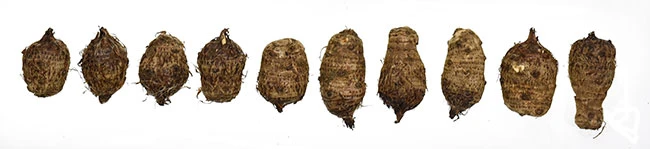
The row of really large malanga are from the supermarkets within one block of the FLAAR offices (in suburban Guatemala City).
The parallel row of significantly smaller, and not so flush malanga roots are from the market of Senahu.
Until I can see and photograph the flowers, I am making an early guess that the small ones are Xanthosoma species, though most of the Xanthosoma species shown on the Internet are longer.
In the Q’eqchi’ Mayan market of Senahu (Alta Verapaz) there were also really small roots, also called malanga. We would need to find the leaves and flowers to tell whether this is a different species or just a different variety. We estimate these smaller ones are Xanthosoma species.
PDFs, Articles, Books on Xanthosoma sagittifolium, Malanga
ARÁUZ, J. C. and J. M. ÑURINDA
2009
Aprovechamiento del tubérculo Malanga (Xanthosoma sagittifolium) como materia prima para el desarrollo de un nuevo producto agroindustrial tipo Snacks, en el período de Julio 2008- julio 2009. Universidad Centroamericana. 61 pages.
Available online:
www.monografias.com/trabajos-pdf3/tuberculo-malaga-producto-snaks/tuberculo-malaga-producto-snaks.pdf
BRONSON, B.
1966
oots and Subsistence of the Ancient Maya. Southwestern Journal of Anthropology. Vol. 22, No. 3. Pages 251-279.
Note: in FLAAR we have a copy that was generously sent to us, if you want this article, please let us known so we can send it for free to you.
CHANDRASEKARA, A. and KUMAR, T.
2016
Roots and tuber crops as functional foods: a review on phytochemical constituents and their potential health benefits. International Journal of Food Science. Vol. 2016. Pages 1-16.
Available Online:
www.hindawi.com/journals/ijfs/2016/3631647/
GALLUZZI, G. and I. LÓPEZ
2014
Conservation and use of genetic resources of underutilized crops in the Americas- A Continental Analysis. Sustainability. No. 6. Pages 980-1017.
Available Online:
www.mdpi.com/2071-1050/6/2/980/pdf
GONCALVES, E. G.
2011
The commonly cultivated species of Xanthosoma Schott (Araceae), including four new species. Aroideana, Vol. 34. Pages 1-21
Available Online:
www.aroid.org/aroidl-archive/attachments/170124104701-1.pdf
HERNÁNDEZ, J. E. and J. LEÓN
1992
Cultivos Marginados, otra perspectiva de 1492. Organización de las Naciones Unidas para la Agricultura y la Alimentación. 345 pages.
Available Online:
www.fao.org/docrep/018/t0646s/t0646s.pdf
Note: Information on X. sagittifolium is available on pages 253-262.
HOSSAIN, S., UDDIN, S., ASADUZZAMAN, M., MUNIRA, S., UDDIN, J., RAFE, R. and M. RAHMAN
2016
Inquiry of analgesic and anti-inflammatory activities of Xanthosoma sagittifolium L.: An effective medicinal plant. Journal of Coastal Life Medicine. Vol. 5, No. 1. Pages 22-26.
MÉRIDA, M.
2013
Recetas de cocina a base de hortalizas nativas de Guatemala. Instituto de Ciencia y Tecnología Agrícolas. 57 Pages.
Available Online:
www.icta.gob.gt/publicaciones/Hortalizas%20nativas/recetas%20 de%20cocina%20a%20base%20de%20hortalizas%20nativas%202013.pdf
Note: recipe of X. sagittifolium is on page 3.
MORTON, J. F.
1972
Cocoyams (Xanthosoma caracú, X. atrovirens and X. nigrum), ancient root- and leaf- vegetables, gaining in economic importance. Florida State Horticultural Society. Vol. 85. Pages 85-94.
Available Online:
http://biblioteca.usac.edu.gt/tesis/01/01_2082.pdf
OGUKWE, C., AMAECHI, P. and C. ENENEBEAKU
2017
Studies on the flowers and stems of two cocoyam varieties: Xanthosoma sagittifolium and Colocasia esculenta. Nat. Prod. Chem. Res. Vol. 5, No. 3. Pages 1-5.
Available Online:
www.researchgate.net/publication/317272866_Studies_on_the
Flowers_and_Stems_of_Two_Cocoyam_Varieties
Xanthosoma_sagittifolium_and_Colocasia_esculenta?ev=srch_pub
POOT, J. E., CENTURIÓN, D., ESPINOSA, J., CÁZARES, J. and M. MIJANGOS
2002
Rescate e identificación de raíces y tubérculos tropicales subexplotados del Estado de Tabasco, México.
Etnobiología. Vol, 2., No. 204. Pages 59-73.
Available Online:
www.asociacionetnobiologica.org.mx/mx2/administrator/Rev.
%20socios/Rev%202%20Art%204.pdf
SABORÍO, F., GÓMEZ, L., TORRES, S and R. VALVERDE
2000
Inducción de floración en tiquisque (Xanthosoma spp) en cinco regiones en Costa Rica. Agronomía Costarricense. Vol. 24, No. 1. Pages 37-45.
Available Online:
www.mag.go.cr/rev_agr/v24n01_037.pdf
SALAZAR, C., ZIZUMBO, C., COLUNGA, P. and S. BRUSH
2016
Contemporary Maya Food System in the Lowlands of Northern Yucatán. On Ethnobotany of México, Chapter 6. Pages 133-150.
Available Online:
www.researchgate.net/publication/301611420_Contemporary
Maya_Food_System_in_the_Lowlands_of_Northern_Yucatan?ev=srch_pub
Note: only chapter 6 is available for free.
Suggested web pages with photos and information
on Xanthosoma sagittifolium
www.cabi.org/isc/datasheet/56989
Information, photos and map location.
www.plantasyhongos.es/herbarium/htm/Xanthosoma_sagittifolium.htm
Photos.
http://tropical.theferns.info/viewtropical.php?id=Xanthosoma+sagittifolium
Information and photos.
www.missouribotanicalgarden.org/PlantFinder/PlantFinderDetails.aspx?kempercode=c752