Merry Christmas 2024 and Happy New Year 2025
Posted December 24, 2024
by Nicholas Hellmuth
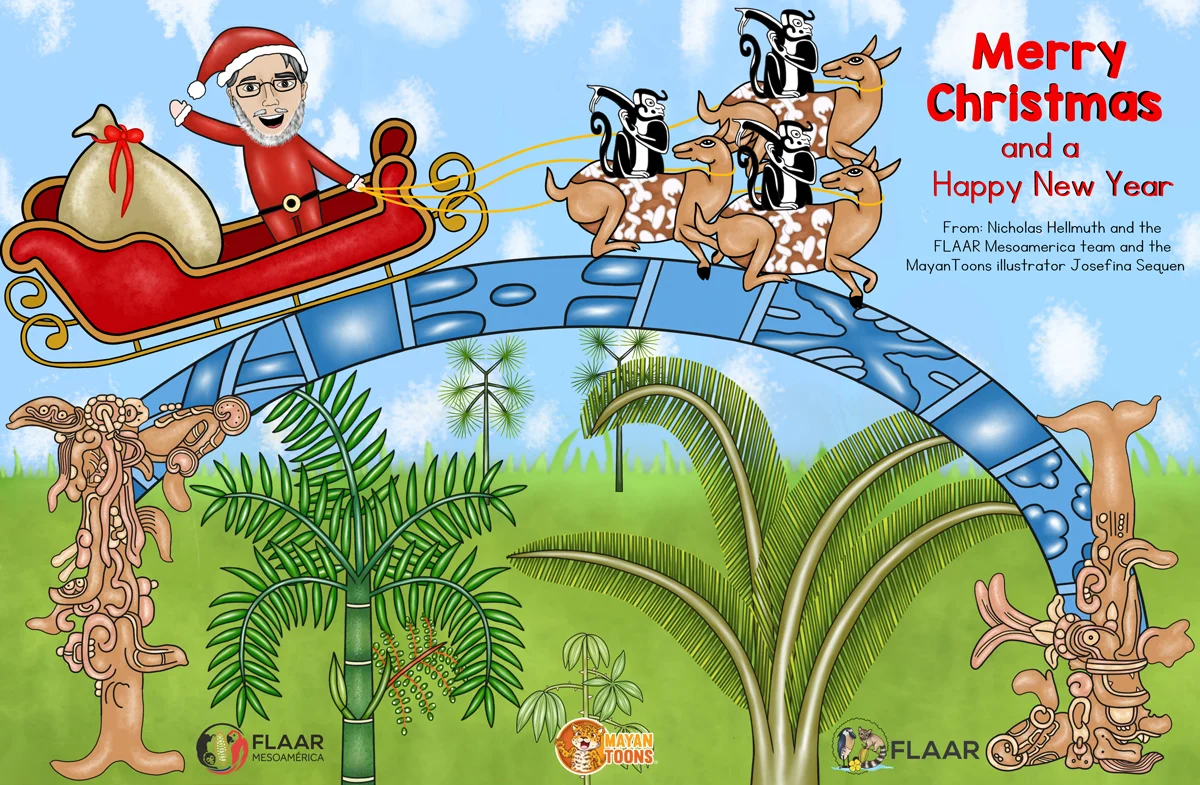
This is “Santa Nicholas” being pulled by native deer of Guatemala. In Classic Maya art deer are associated with monkeys. And paintings of monkeys often show them with deer antlers and deer ears. We have four volumes to release in 2025 from our 2024 research on the iconography of deer in Maya art plus a monumental volume on iconography of monkeys.
The circular path is the Maya Sky Band with celestial motifs. We have published many PDFs on this topic. Just Google Sky Band Hellmuth FLAAR.
Often the Sky Band is the body of a Bicephalic Cosmic Monster, with “starry-eyed” deer at the left and an upside-down Quadripartite Badge Headdress monster at the right. Just Google Bicephalic Cosmic Monster, crocodile lecture, Hellmuth and you will see lots of Maya art with this monster. We have six chapters of our lecture on iconography of crocodiles in Maya art for The Pre-Columbian Society, University of Pennsylvania Museum. Peccary are not shown in this Christmas card, but our research results on iconography of peccary in Maya art are already published–just Google peccary, Maya iconography, Hellmuth.
The setting features palm trees since that will be our focus for the RBM area of Peten in 2025: which palms have edible parts for the Classic Maya and which palms were used as thatch and walls. In recent years for our CONAP project of the RBM we have studied tasiste palms as an indicator of savannas in PNYNN. Tasiste palm, nance trees, and calabash trees (Crescentia cujete) tend to grow in the Savanna East of Nakum and the Savanna West of Naranjo Sa’al. We have also studied the Savanna of 3 Fern Species and lots of tasistal areas in the RBM and on the west side of Arroyo Petexbatun, upstream from Rio la Pasion, Sayaxche.