How did the Classic Maya use a Tasistal area 2000 years ago?
Posted May 20, 2020
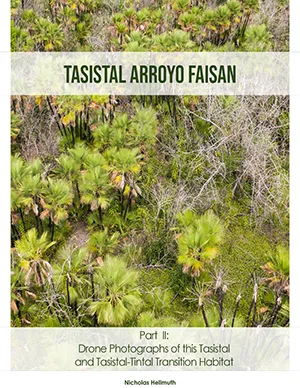
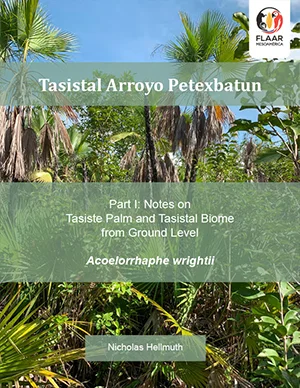
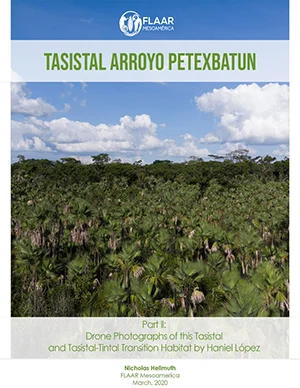
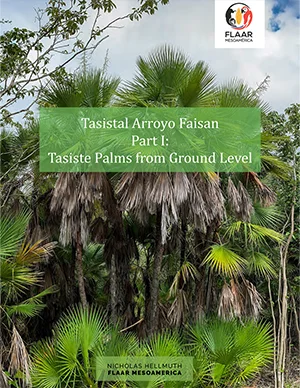
There are areas with solid masses of tasiste palm, Acoelorrhaphe wrightii in Belize and in several areas of Peten. The four reports below are the first photographic documentation of any tasistal in Peten with high resolution photos and with panorama views. Plus the first with photos from above.
We documented Tasiste palms in all three seasonally inundated savannas in Parque Nacional Yaxha Nakum Naranjo courtesy of the co-administrators and with the assistance of park rangers of PNYNN. But in a grassland savanna (or fern savanna) tasiste palms are widely scattered. In a tasistal these palms are solid; literally so solid that often you can’t walk between them.
Julian Mariona, owner of the family friendly Hotel Ecologico Posada Caribe showed us the Tasistal Arroyo Petexbatun in October 2019, when he learned that we were interested in atypical and unexplored biodiverse ecosystems. So we returned twice to do additional photography. On one of these visits he told us there was a second comparable tasistal a few kilometers away, so we returned there in early 2020.
Rio Petexbatun and Lake Petexbatun area
Municipio de Sayaxche, Peten, Guatemala
I first came to Peten circa 1993, as a backpacker. I worked at Tikal for a solid 12 months as a student intern in 1965, and lived multiple-months per year for several years while mapping Yaxha together with Miguel Orrego and helpful students. But in my over half a century in Tabasco, Campeche, Quintana Roo, Yucatan, Peten, and Belize, no one had taken me to a tasistal ecosystem. So now that I have seen two of these tasistals, I would like to share the photographs with the world. I hope that students at the universities of Guatemala will be inspired to do their thesis or dissertation on flora, fauna, ecology, geology, of these tasistal areas. We hope professors and researchers will now know of these still pristine areas (because in a few years they will all be cut down for cattle ranches or African palm oil plantations).