Ethnoecology: a unique and integrated approach to knowledge
Posted August 25, 2024
by Researcher Alejandra Valenzuela
Edited by Sergio D’angelo Jerez
Ethnoecology is one of many ethnosciences, which derived from the study of ethnobiology. In that sense, and if we were to analyze the etymology of the word ethnobiology, we have that the Latin root ethno- means ethnicity, community or culture; bios- means life, and -ology is a suffix that means “the study of”. Taking this as a starting point, a primary definition for ethnoecology could be the study of the relationship between human communities with the life and environment that surrounds them.
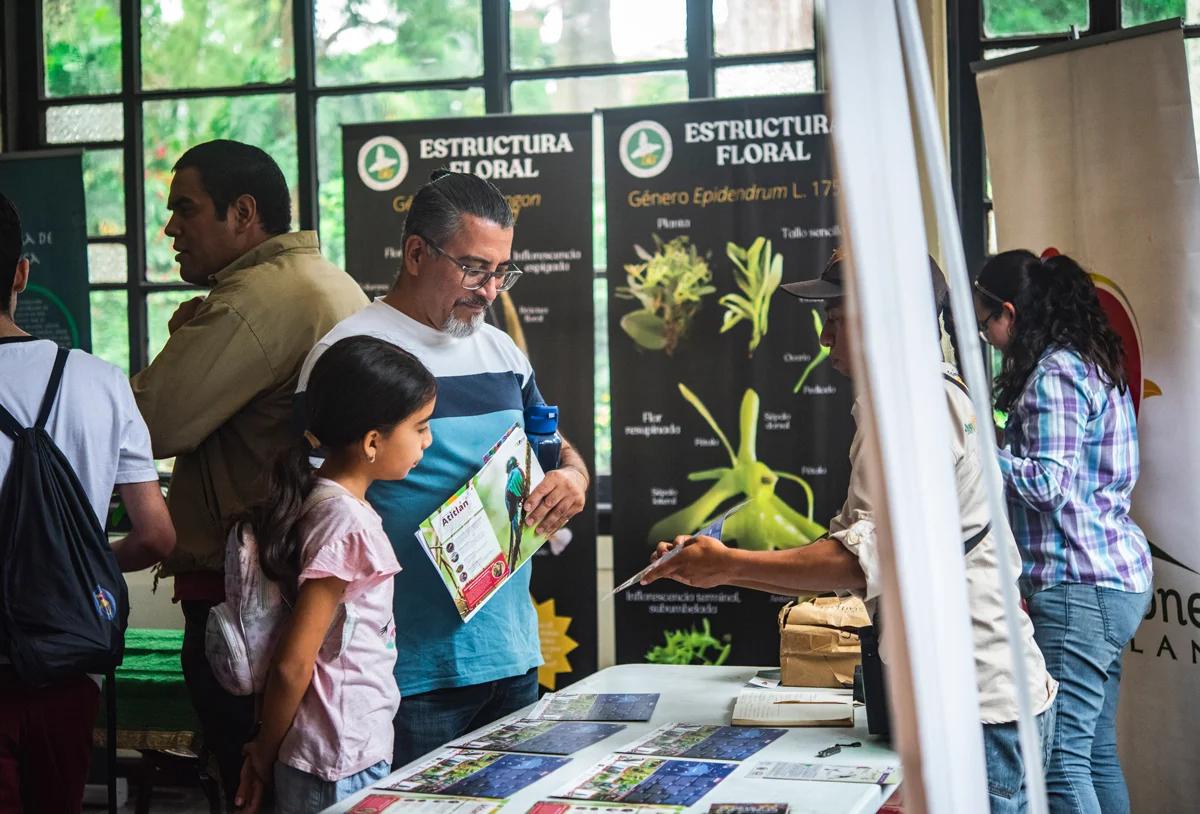
During the first FLAAR Fest, in November 2023, people were invited to learn about Guatemala’s diversity and its importance for society, among other topics related to ethnobiology. Photo by David Arrivillaga.
To dive deeper into its concept, let’s see what is the relation between ethnoecology and biology. Similar to the branches of biology itself, ethnobiology’s three main branches are: ethnobotany, ethnozoology and ethnoecology. Ethnobotany studies how different human communities use the plants that grow in their environment. Ethnozoology, on the other hand, studies human communities and their relation to animals instead of plants. Moreover, ethnoecology has the intention to understand the integrated panorama that exists between a community and the physical and biological world that surrounds it. This includes biotic factors like flora, fauna, fungi and microorganisms, as well as abiotic factors like weather, hydric resources and soil conditions.
The term “ethnoecology” appeared in scientific research for the first time in 1954, in a dissertation written by the anthropologist Harold Conklin. In it, he analyzed the life of an indigenous community of the Philippines called the Hanunoo and their understanding of the world. He also reviewed their relationship with things like native agricultural and plant-naming strategies, shifting cultivation practices, and their knowledge regarding environmental factors like the seasons, climate and soil properties.
Since then, hundreds of studies have been conducted in the field of ethnoecology, within which, a large percentage has focused on studying communities of the American continent. Part of this interest may be attributed to the large diversity found in the American countries, both from a biodiverse and natural point of view, as in an anthropological or social perspective.
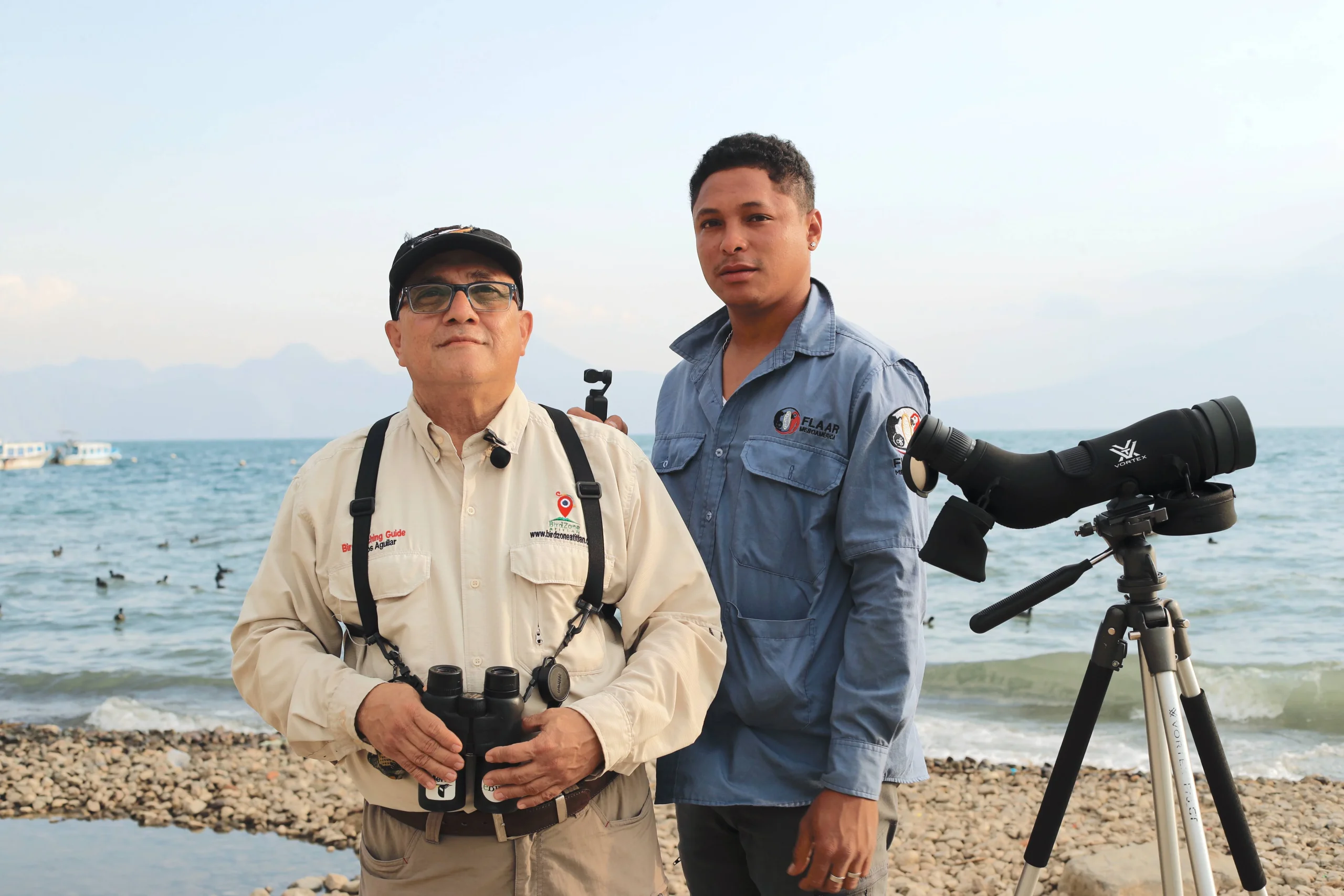
There are many researchers that have studied the relationship between nature and society in Guatemala, as well as organizations that focus on conserving the knowledge of local communities and nature. Here Carlos Aguilar (at the left), from the local organization Asociación Vivamos Mejor was sharing with our staff about the work they have done in Atitlán to protect birds. Panajachel, Atitlán; February 2024. Photo by Alejandra Gutiérrez.
Guatemala is certainly one of those countries where natural and biological diversity abounds. To start with, it is considered one of the 19 megadiverse countries, and it is also considered pluricultural. This is not a surprise since Guatemala has over 20 different linguistic communities, most of which are Mayan. Also, due to its position between two oceans, and two continental masses, it encloses a large variety of ecoregions, which come with high levels of endemism.
This makes Guatemala a country with an exceptional potential for ethnoecological research. In fact, this biological and cultural singularity and diversity is what captured the hearts of the people responsible for the existence and research potential of FLAAR Mesoamérica.
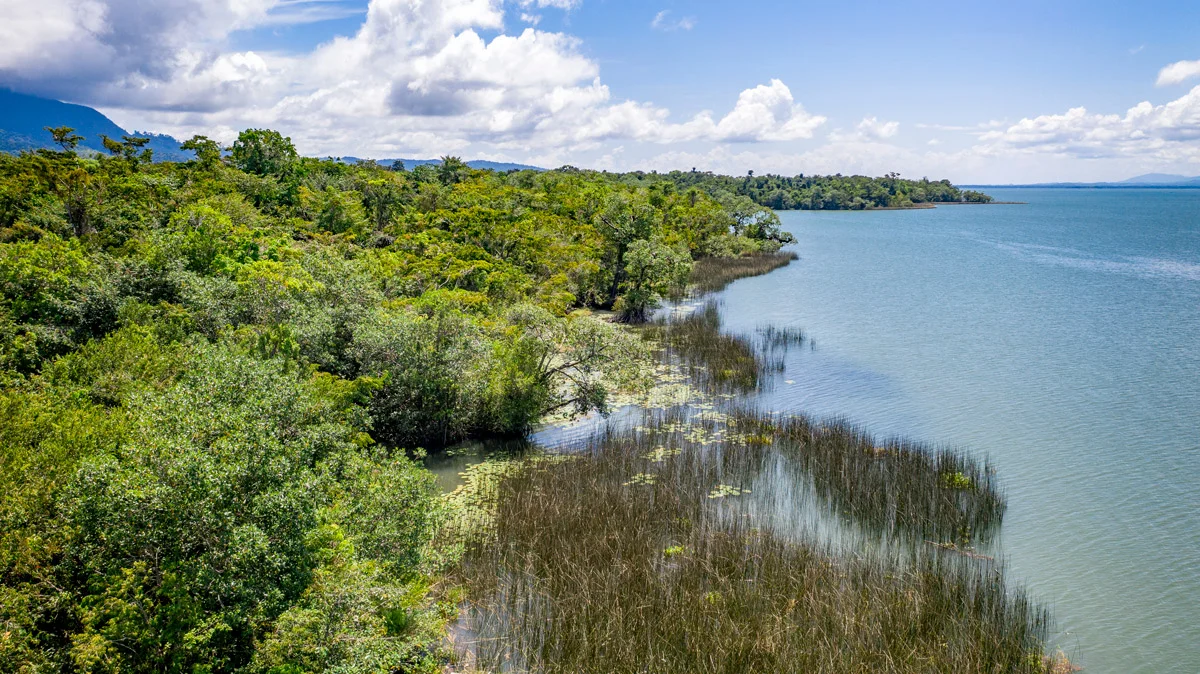
Livingston ecosystem. “El Golfete”, Río Dulce; March 2021. Drone Photo by Haniel López.
It all started in 1965 when our co-founder, Nicholas Hellmuth, worked for a group of archeologists that were mapping the Maya City of Tikal. At the young age of 19, Nicholas worked for over a year as an intern for this project, with a passion for culture, photography, and a growing love for Guatemala’s amazing biodiversity. Since then, he has dedicated his whole life to visiting, doing research, photographing, documenting, and learning all about the species that make up the beautiful ecosystems of the region, and the relationship that different local communities have or have had with them.
Today, FLAAR and FLAAR Mesoamérica have become the vehicle for Dr. Nicholas’ interest regarding the natural world. Nowadays, the organization focuses on the study of the local uses for plants, mushrooms and animals as medicine, dye, food, construction, and their cultural or religious significance. In addition, another approach to our research is to look for certain species that were depicted in the iconography of the Ancient Maya cultures of Mesoamerica.
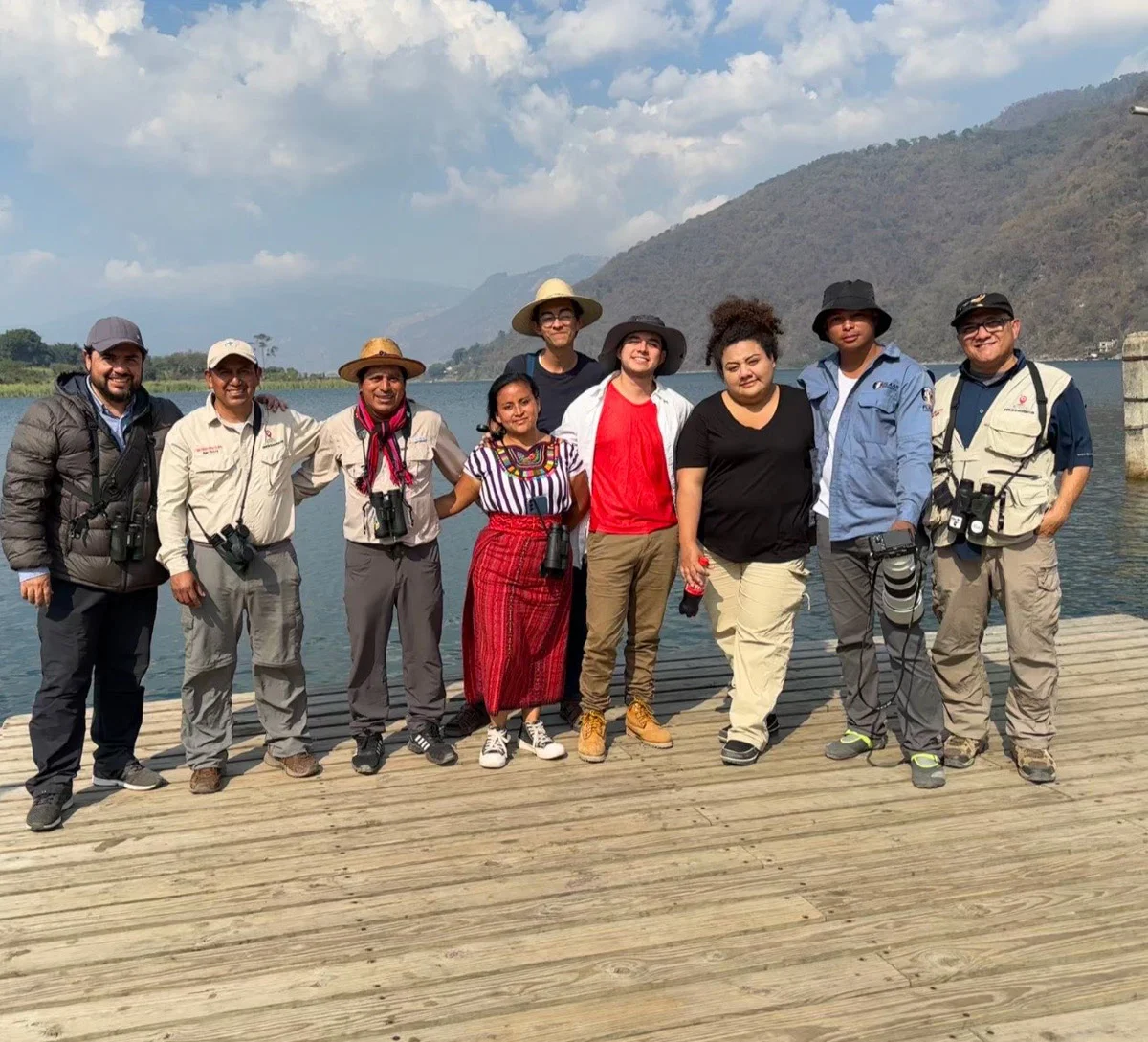
Both the FLAAR Mesoamérica team and the Association Vivamos Mejor team posed with local birding tour guides from Santiago, Atitlán. San Lucas Toliman, Atitlán; February 14 2024. FLAAR Mesoamérica Photo Archive.
FLAAR Mesoamerica has chosen this particular approach to the ethnosciences, but the applications for these sciences are vast. For instance, these may integrate local and global wisdom and we can find them useful in fields like medicine, conservation and ecology, as well as in the development of ecological and cultural governmental policies. The potential of, not only ethnoecology, but also ethnobiology and all its branches, is huge. The integration of local, cultural and biological knowledge is a necessary tool in today’s worldviews, and it could aid in finding consolidating answers for today’s problems.
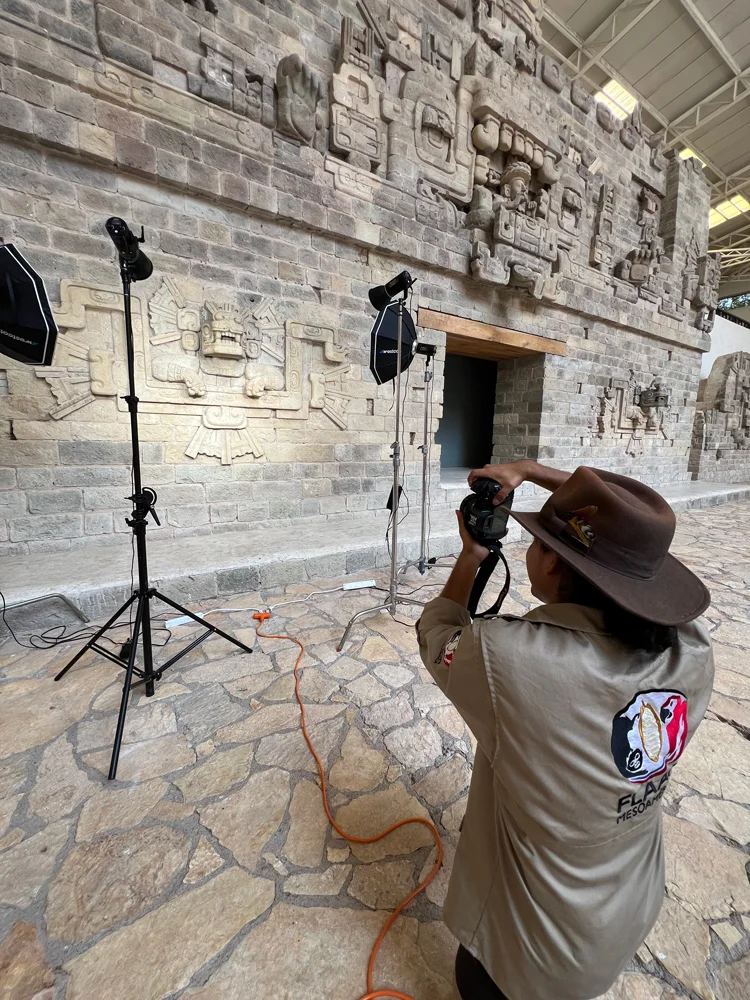
Jimmy Estrada photographing a jaguar mural in Copán, Honduras. May 2024. Photo by Vivian Hurtado.
References:
- 2012
- La Etnobiología y la Etnoecología en Brasil hoy, 1. Etnoecológica 9 (1): 75-77.
- 2021
- Los pueblos indígenas de Guatemala. FLAAR Mesoamérica.
Available online:
https://flaar-mesoamerica.org/2021/08/26/los-pueblos-indigenas-de-guatemala/
- 2023
- Cacao in the Mayan Culture and other interesting facts. FLAAR Mesoamérica.
Available online:
https://flaar-mesoamerica.org/2023/07/07/cacao-in-the-mayan-culture-and-other-interesting-facts/
- 2022
- Homegarden Variation and Medicinal Plant Sharing among the Q’eqchi’ Maya of Guatemala. Econ Bot 76, 16–33.
Available online:
https://doi.org/10.1007/s12231-021-09537-0
- 2012
- La Etnoecología hoy: Panorama, avances, desafíos. Etnoecológica 9 (1): 1-16.